On the growing tension between human and artificial intelligence – and why being more stupid might be the smartest strategy for brands.
Why this topic? Because the tension between human and artificial intelligence is everywhere. Every day brings a new development, and we’re constantly trying to make sense of a dizzying conversation that asks us to see AI as either a tool or a threat to human thinking, creativity and even existence.
From Pope Leo’s warning about AI to A24’s partnership with Google’s DeepMind, from surveillance repackaged as a chic accessory to AI products becoming extensions of our bodies, it’s a vast and tangled subject to navigate.
There are countless ways to explore this unprecedented and evolving relationship between humans and machines, and what it means for our intelligence. But we think a lot of these conversations have overlooked the other side of the coin: how the meaning – and value – of stupidity changes as AI advances and becomes more deeply embedded in everyday life.
Maybe stupidity isn’t something to fear. In an age saturated with information, perhaps there’s something valuable about not knowing. About not having an answer for everything, but asking better questions instead. About embracing ambiguity and nuance rather than defaulting to rigid, logical thinking. As the American actor and director John Waters put it, "Sometimes, stupid and cute are enough."
In his 1983 book, Frames Of The Mind, Howard Gardner, professor of cognition and education of Harvard University, challenged the notion of intelligence as something singular. Instead, his Theory of Multiple Intelligences proposed that intelligence manifests in eight different forms which each of us possess to varying degrees. Intelligence, and in turn stupidity, is broader and more diffused than we’d been taught.
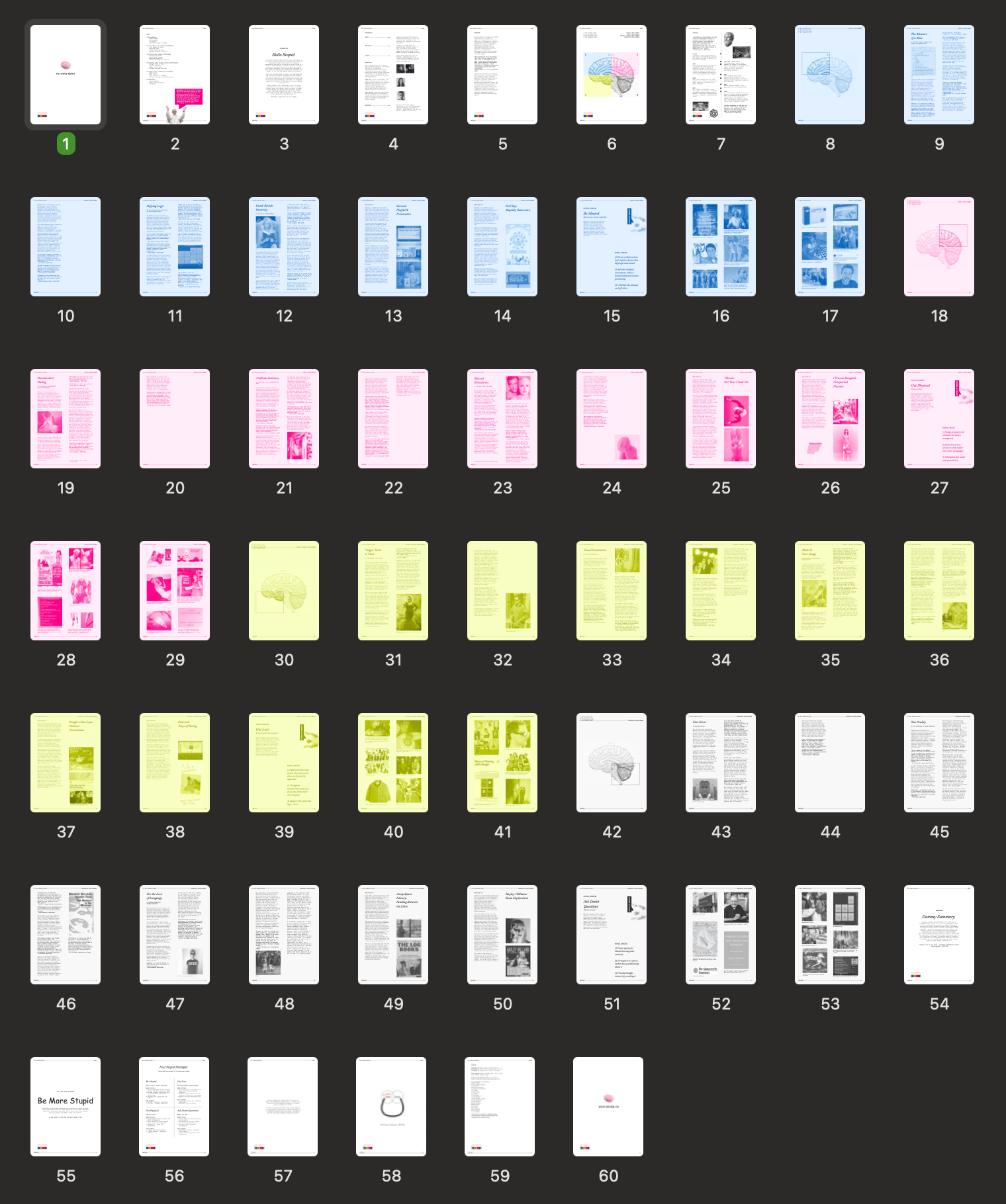
Considering the different brain functions that each lobe executes, we’ve mapped elements of Howard Gardner’s Theory of Multiple Intelligences onto each. This is very much a botched, simplified, probably insulting take on neuroscience and Gardner’s work. But for the purpose of this REPORT, and to explore how intelligence and stupidity manifests in culture and for brands, we've found this a useful framework to adopt. Over 60 risograph soaked pages you’ll find a collection of cultural analysis, brand case studies, strategic considerations and image essays.
At the end, we set out four strategies and 12 tactics for how brands can outsmart AI by being not less, but more, stupid. The full report is available exclusively to INDIVIDUAL and TEAM members, so if you’re not yet a member, you'd be stupid not to sign-up.
Protein AGENCY provides insight, foresight and strategy for global brands that's rooted in culture and the collective knowledge of SEED CLUB - our decentralised research community of 500+ global experts.