The Pop-Up Problem
As “immersive” drifts further from what it was ever meant to be, people aren’t just disappointed – they’re exposing a format that’s starting to feel hollow.
My feeds have been flooded lately with people complaining about brand experiences. Not just underwhelmed, but sort of openly mocking them. Filming their disappointment. Posting the receipts in real time, almost like they’re still trying to process it themselves.
The more I look at it, the more it feels like a structural collapse rather than a run of bad luck. Like something has quietly broken at the level of the format itself, and no one is entirely sure when it started. To understand why, it helps to remember what immersion was actually supposed to mean, and how far the pop-up has drifted from that original promise.
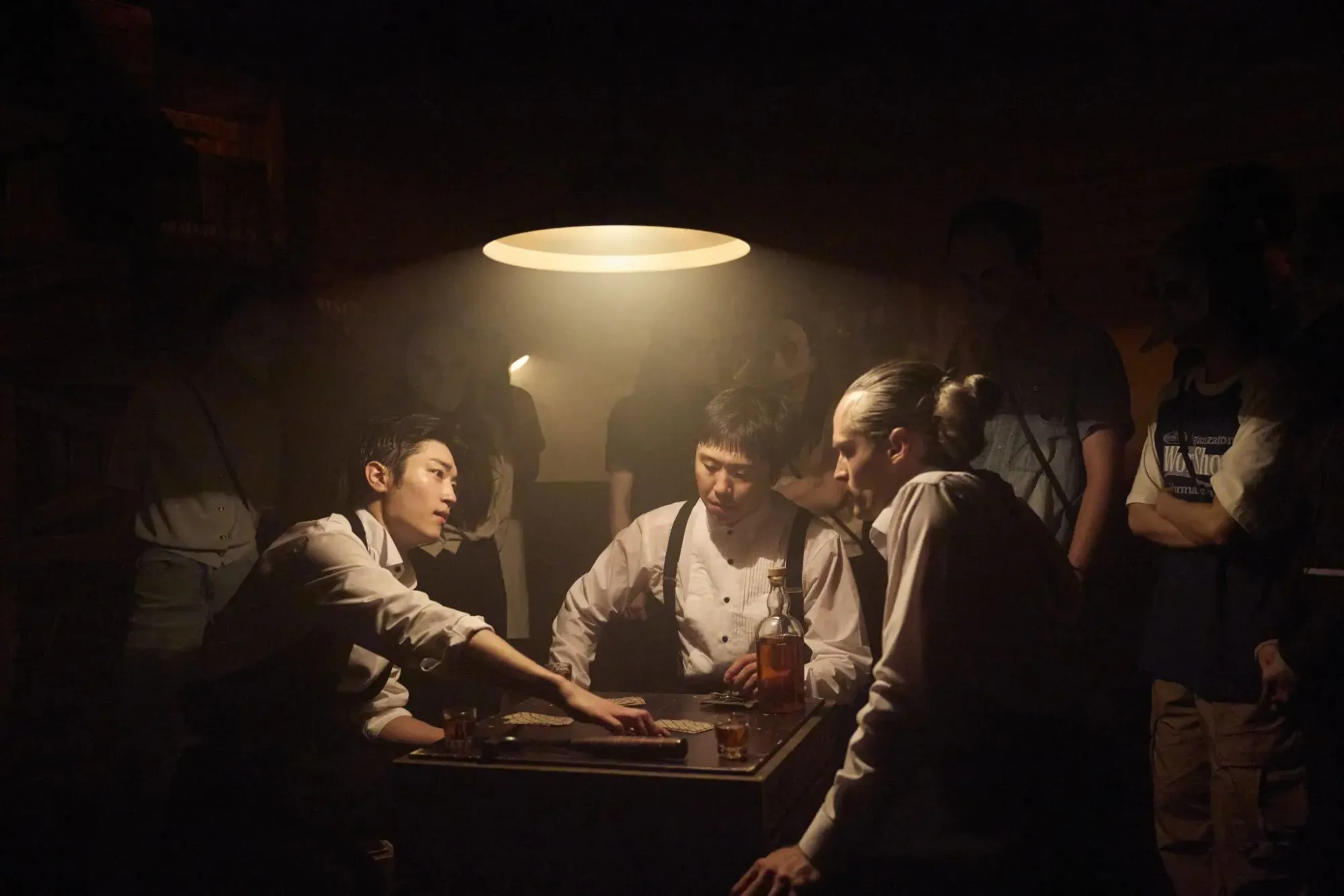
Punchdrunk, the British theatre company founded in 2000, is among the most credible living definitions of the word “immersive”. Its production Sleep No More – which has run continuously in New York since 2011, making it the longest-running immersive show in the world – is built on deliberate opacity. Audience members wear masks and move freely through multi-storey spaces, encountering a narrative that no two people experience identically. You cannot pre-empt it. You cannot fully capture or share it. You do not really know what will happen as it unfolds around you. The experience withholds as much as it reveals, and that withholding is precisely the mechanism by which it generates meaning.

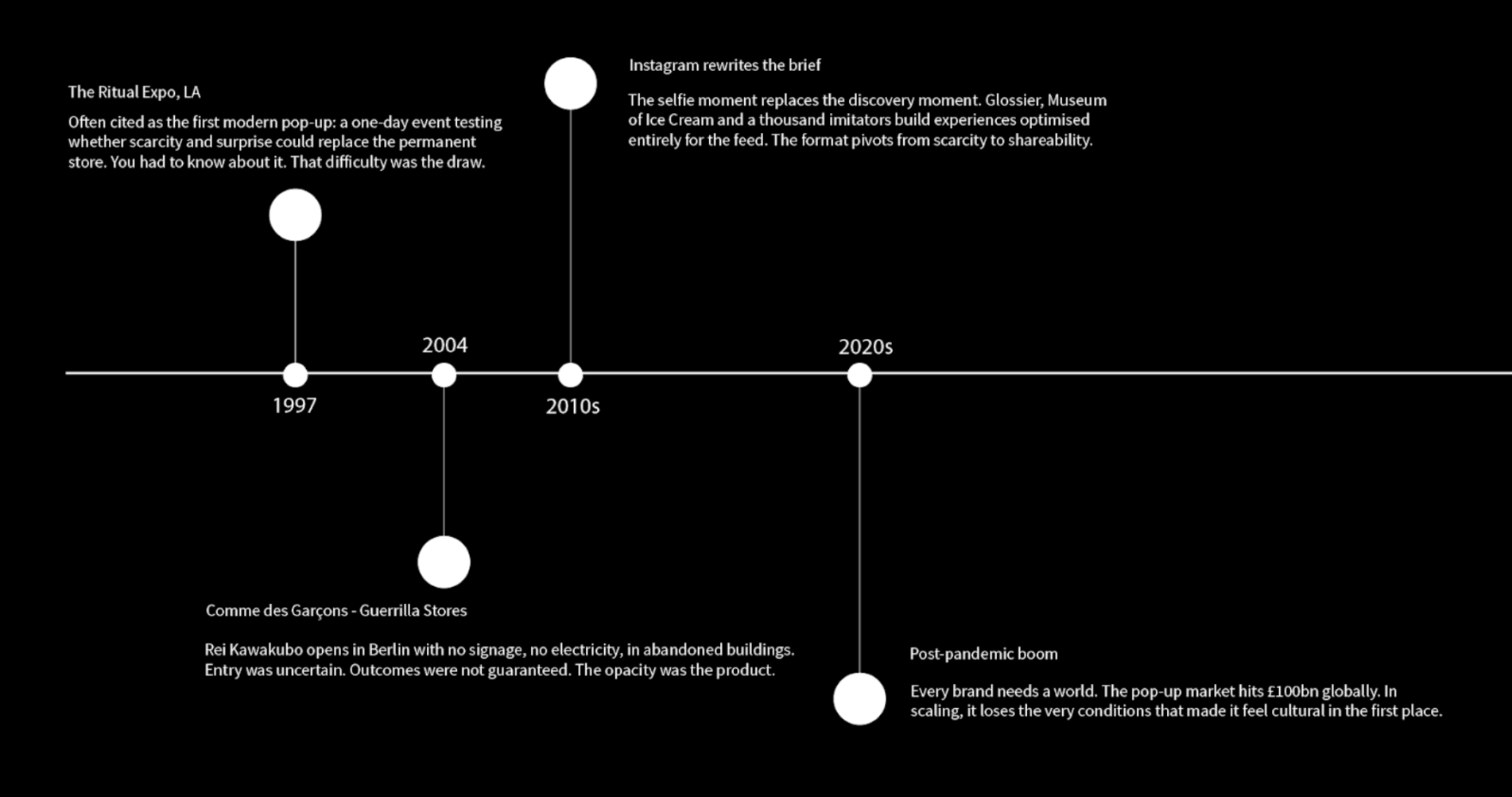
Now compare that to what a brand activation calls an “immersive” pop-up in 2026. The word has been stretched so far from its origin that it barely carries any descriptive weight anymore. It’s become a brief rather than a condition of experience, a box to tick, a line in a press release that no one reads too closely because everyone already understands the shorthand: curated lighting, a selfie wall and a QR code waiting quietly by the exit.
How We Got Here

The most clarifying example arrived last month. Polymarket, the prediction market platform, took over a Washington DC sports bar and rebranded it “The Situation Room”. On paper, the concept was bold: walls of screens showing Bloomberg terminals, live X feeds, flight radar, real-time political odds. There was also a bar built for people to monitor the world in real time.
It was widely reported that, on the opening night, the TVs didn’t work. A small crowd stood outside in the rain while an electrical issue delayed entry. But when they finally got in, the centrepiece – a wall-to-wall screen experience – blacked out. A dimly lit sports bar with a glowing LED orb in the middle turned out to be the highlight. Outside, an anti-gambling truck circled the building, and a trademark cease-and-desist was issued. The growth strategist behind the pop-up later told reporters the goal was virality. According to Wired, the pop-up was a “disaster”.

As one attendee put it, it was “kind of embarrassing to mess this up in DC.” But the embarrassment isn’t really about the technical failure. It’s about what the failure revealed: the entire concept was a content stunt dressed as an experience. When the screens went dark, there was nothing left.
Something similar happened again a few days later. Barbie Dream Fest, billed as the “ultimate immersive fan event” for one of the most globally recognised brands on earth, opened in Fort Lauderdale with tickets priced between £55 and £350. Attendees arrived to find a convention centre with cardboard decorations, three booths and children crying because there was nothing to do. One attendee described it as “so much emptiness... more like a very expensive parade”. Someone on Reddit called it “Barbie Nightmare Fest”. Mattel issued full refunds. The event had been months in the making, co-developed with the brand’s own licensing arm and announced by Mattel’s VP of Global Location Based Entertainment. This was not an unlicensed scam.

The gap between promise and delivery is now so wide that even the world’s most recognisable brands have trouble closing it. The format has broken at the institutional level, optimised for announcement and not for arrival. Scroll any platform right now and the evidence is everywhere. Consumers, in real time, documenting their disappointment.
The Willy Wonka experience in Glasgow. The Bridgerton ball in Detroit. Now Barbie Dream Fest and Polymarket’s pop-up in Washington DC. Each one travels further and faster than any brand’s own promotional material, because failure is the most shareable thing the format currently produces.This is not a critique of bad executions. It is what happens when a cultural idea scales too well. Walk into almost any brand activation today and you already know how to behave. Where to stand. Where to look. Where the photo moment is. The experience does not unfold. It resolves.

People pre-empt the experience before arriving. They know where the photo will be taken. They know how long it will last. The Instagram room is not just dead. It is a punchline. The Event Marketer’s SXSW debrief put it plainly: “lack of intent with experience design doesn’t just make an activation lackluster – it makes it invisible”. The format is being industrialised at precisely the moment audiences are becoming fluent in it. Once a format becomes legible, it stops being immersive.
What The Format Killed
The original pop-up worked because of friction. Comme des Garçons’ Berlin Guerrilla Store had no signage, no electricity and no signpost. You had to hear about it, find it, qualify for it. Retail stripped all of that in the name of optimisation and throughput. Booking systems are seamless. Flows are managed.The pop-up was built on a single promise: that people would share what they encountered. That organic reach would justify the spend. The content engine was the product. But the engine has inverted. If audiences are now filming their disappointment rather than their delight, has the pop-up lost its only real function as a content engine? And if people no longer want to share, what is the format actually for?
However, all is not lost. Here are two examples of brands/businesses making pop-ups relevant again:
Case Study: Crossby Studios
Harry Nuriev is the most consistent practitioner of the counter-position. His spaces are built around a point of view that exists independently of the product it is ostensibly housing. For the Nike x Skims Paris pop-up in February 2026, Crossby Studios designed the interior around a study of the female form rather than around the product. Curved geometries, a central circular lounge, a deliberately dark palette. Press described it as “dismantling the traditional boundaries between retail environments and art installations”, a case study in how spatial design can amplify a brand’s narrative through subtle, high-quality intervention. It was reviewed as an environment, not as a stunt.
Its Frankie Shop activation in Los Angeles, timed to art week, not fashion week, placed clothing almost incidentally among silver-filmed water coolers and plastic-wrapped chairs in a building wrapped entirely in reflective film. The space did not guide behaviour toward a single output. It allowed for ambiguity, even disinterest. His H&M jewel box in Paris required visitors to physically pull open archive cabinets to access the collection, friction introduced deliberately that now most brands remove it entirely. Nuriev himself has called the trade show and activation circuit “overly professionalised, catering only to niche audiences”, and is now building a festival format that combines music, dance and design into something structurally unreplicable. That refusal to resolve is the whole point.


Crossby Studios: Nike x Skims, Its Frankie Shop, H&M
Case Study: Nothing
Where Crosby Studios brings conceptual rigour to how a brand’s physical space is designed, Nothing demonstrates something different but equally instructive: that the most immersive pop-up you can build is one where the audience already belongs to the world before they walk in.
Nothing does not follow the recipe. There is no selfie room or guided flow toward a merch table. Its physical events are built backwards from community rather than forwards from a brand communications brief; and the difference is immediately legible in how people talk about them.
The Phone (3) “Come to Play” launch in London, held at Magazine London in Greenwich in July 2025, was structured around community members meeting for drinks nearby before heading to the venue together. On arrival, Nothing staff were DJing, a countdown to the keynote ran on the main screen and doors opened after the presentation into a second room with interactive exhibits, product demos, a boules game with prizes and live performances from AJ Tracey and Tiffany Calver.

Community members who attended called it “definitely the best event we've ever put on, both in terms of scale and vibes”. Not a single reported comment mentioned the lighting, the selfie moment or the QR code.
For the European launch of the same device, Nothing staged “Berlin’s Smallest Fashion Show”: miniature designer outfits at 1:10 scale, placed at creative locations across the city for two weeks, as an open invitation to photograph them and share, with the chance to win the phone. There was no warehouse or branded room. Instead, the city itself was the venue and the experience was distributed, open-ended and impossible to fully resolve.

The Phone (2a) Plus Community Edition went even further. Co-designed entirely by community members (hardware finish, packaging and campaign), it was released in 1,000 units that sold out in 15 minutes. Carl Pei describes Nothing's approach as a form of “arbitrage”: turning the brand’s disadvantages into advantages. Industry titans cannot start a YouTube channel and come across as authentic. Nothing can. The launch is the event. The community is the space. You cannot replicate that with a better selfie wall.
A Question Of Scale
The pop-up did not die. It scaled. And in scaling, it converted an act of cultural disruption into a line item on a marketing plan. What began as opacity, something you had to find, earn, decode, became a standardised room that anyone with a production budget and a photographer can build over a weekend.
The deeper question is not why these experiences keep failing but why brands keep commissioning them anyway.
The pop-up has become a box to tick: proof that a brand showed up in culture, regardless of whether culture noticed. Millions of pounds spent on an experience that generates a few minutes of dwell time, a TikTok of disappointment and a debrief nobody reads.
The formats that still work share one quality. They refuse to be fully consumed. They leave gaps. They reward the people who already belong, rather than optimising for everyone who is just passing through. That is not a production value. If anything, it is more like a philosophy. And right now, almost nobody commissioning pop-ups has it.
The Instagram room was never really the problem. It was a symptom of a deeper error in brief: the belief that an experience is something you build for people to move through, rather than something they are part of. Until that changes, brands will keep spending a fortune to produce a format that is completely indistinguishable and content that proves their own irrelevance.
| SEED | #8401 |
|---|---|
| DATE | 14.04.26 |
| PLANTED BY | ANA RAUCEA |