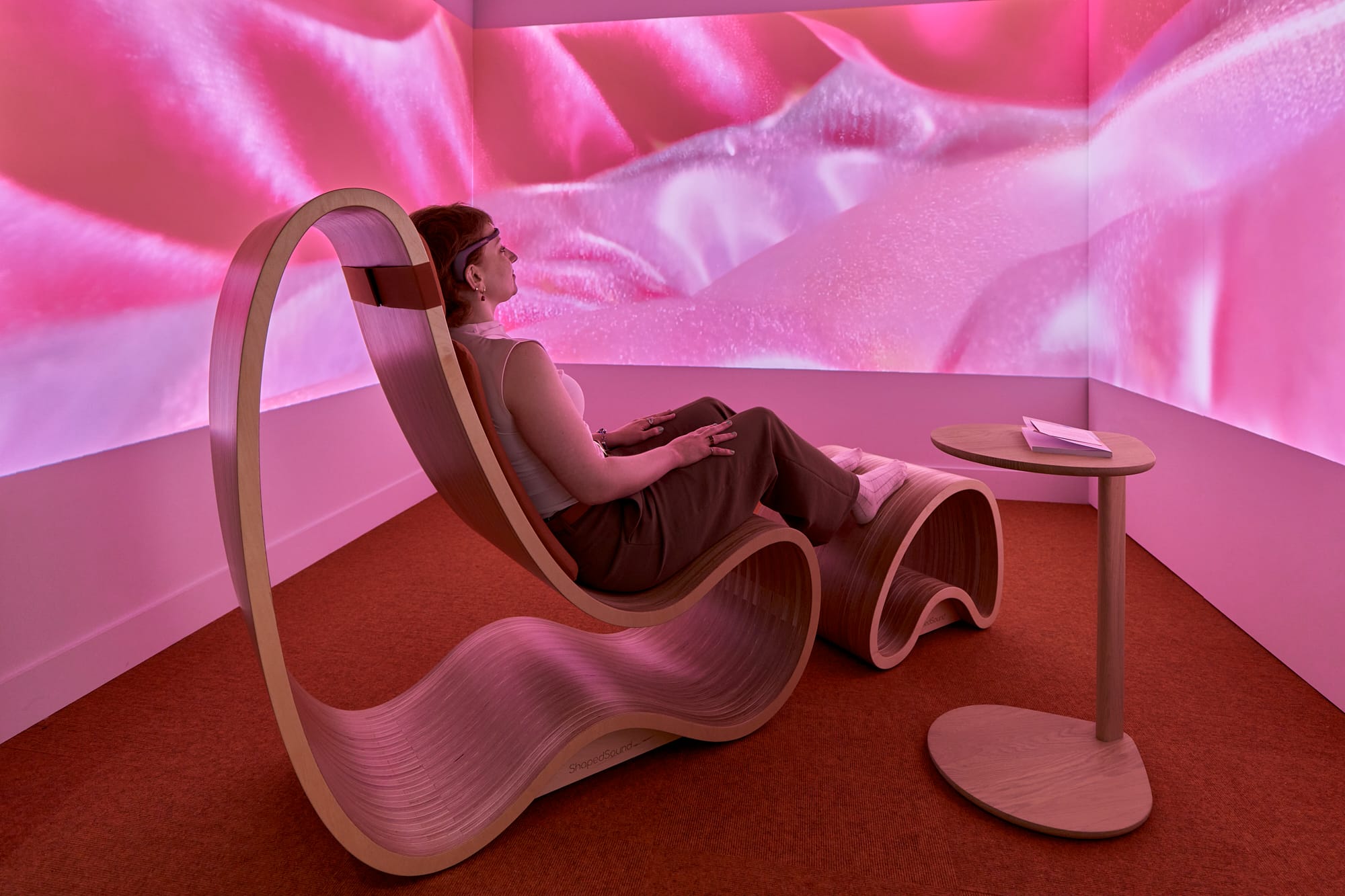
Kinda Studios is a neuroaesthetics studio and lab exploring how art, design and environments shape the nervous system. Working across brands, cultural institutions and live experiences, the studio translates neuroscience into sensory design – decoding how we feel, respond and behave in the spaces we move through.

Inspired by its SXSW London talk at Protein STUDIOS (it is also a member upstairs) titled WTF Is Neuroaesthetics?, we speak to co-founder Robyn Landau about the science of experience, and why the future of design starts in the body.

Protein: Tell us about how and why you started thinking about neuroaesthetics as something worth focusing on, and something that became important to you.

Robyn Landau: Kinda was founded six years ago. We’re a neuroaesthetics studio and lab, and we founded the company in response to this idea that neuroaesthetics as a field of research was really exploding in academic circles, but nobody was applying it to real-world creative and cultural experiences.

Neuroaesthetics looks at the neuroscience of aesthetics, which doesn’t really mean much when you say it like that, but basically it’s about how our brain and body respond to art, culture, design, spaces and environments – all of the sensory ingredients that make up an experience. So the sounds, smells, colours, textures, shapes, densities, movements, performances – all of those things.

Emergence​: A Neurosensory Journey for Creative Expansion by Kinda Studios
What has the research uncovered?

That these experiences, whether we’re conscious of it or not, affect how we feel, act and behave on an unconscious level. They’re kind of hardwired into our DNA. Our brains and bodies are constantly responding to them, which shapes how we feel.

Now we have a deeper understanding from neuroscience that helps us understand more intimately how these things shape us emotionally, and we can begin applying that insight into creative work.

An easy way to think about it is: we deeply understand sleep for health – how many hours we need, what type of sleep matters. We understand fitness and physical activity. We understand nutrition and what needs to go on our plate to get the right nutrients. And now we're beginning to understand culture, creativity, art and experience at that same deeper level.

So the work we do is about accelerating academic insight into creative projects, so we can make an impact on the ground within the social tapestry of our experiences.

When Kinda started six years ago compared to today, how far have we come along in that journey? Not only in terms of scientific research, but also in terms of popular consciousness?

The thing I go around saying is that we’re at an inflection point now, where we know more about the brain and body than ever before, and we also have more technological tools at our fingertips than ever before. We're in this cultural moment of change.

But at the same time, we still know only a fraction of what’s going on in the brain. We still know barely anything, even though we know more than ever before.

To answer your question directly, though, the field has grown tremendously. When we started six years ago, nobody knew what neuroaesthetics was.

Was it a case of constantly having to convince people and explain the value of it all?

Yeah. There was already quite a lot of academic research in the field, but academia works in silos, and the work doesn't necessarily reach the creative industry.

It’s a sexy word – people like the term neuroaesthetics – but nobody really knew what it meant. We’d explain it to people, and they’d leave the call saying, “That’s fascinating, I’ve never heard of it before. Not really sure how to work with you, but nice to chat.”

I guess what we discovered is that when you’re doing something pioneering – something at the forefront of a field – you become immersed in that world, but the market isn’t there yet. A huge amount of the work is figuring out how to communicate it.

Not only translating complex science into something meaningful and useful, but communicating it in a way that helps people understand how it adds value to their business – and why it’s not just something sitting at the bottom of the budget.

Fast forward six years and the field has transformed quite a lot. A book called Your Brain on Art came out maybe three years ago. A lot of people read it. It was written by Susan Magsamen, who heads up the neuroaesthetics lab at Johns Hopkins, and Ivy Ross, who’s Head of Hardware at Google. That book did a brilliant job of explaining neuroaesthetics to a broader audience. I’d say it really helped propel the field within the creative industries.

At the same time, Kinda eventually amassed enough case studies for people to understand how this actually works in practice. I think those things together have contributed to more people wanting to be involved and part of the movement.

Who does Kinda work with, or want to work with? Where can you have the most impact?

It’s a good question. I’ve been scoping some of that in my book. Our work gets pulled into a lot of different directions because, if we were academic researchers, we’d probably focus on one field – neuroarchitecture, music, museums, visual art, performance, dance. But the real world doesn’t work in isolation. So I like to say we’re incredibly niche but work in a very broad way, because we touch so many worlds.

We work with brands, helping them understand the science behind their creative campaigns and how to lean into it with greater impact. We’ve worked with On, Nike, Mars, healthcare providers like Bupa, museums and cultural institutions like the Barbican and the National Gallery. We also work a lot in hospitality and hotels. Spas are something we think should lean much more heavily into this work.

Can you give an example?

Sure. A good example is a project we did with On and NTS. We helped create a soundtrack scientifically designed to support runners’ mood and energy. We worked with Jyoty, the NTS producer on the project, and gave her a scientific toolkit outlining compositional elements known to influence energy, mood uplift and physiological arousal like BPM.

We then tested multiple iterations in our lab with around 120 runners globally, gathering physiological and subjective responses, before refining the final track. We then ran a further test with 20 runners in London, measuring heart rate dynamics, mood shifts and synchronisation between participants.

The final campaign became much more than a product activation – it turned into a cultural piece involving music, movement and performance. Instead of “here are the shoes”, it became an experience built around feeling. That shift is quite important – from product-first thinking to experience-first thinking.

These brands are interested because if they properly understand this stuff, their campaigns become more impactful, right?

Exactly. Once you have a deeper basis of understanding about how things work, more ideas become possible. Some of it is about driving innovation and more creative thinking. Some of it is much more directly applied to the design of spaces themselves.

We also work across other sectors in similar ways. For example, Nike has an in-house neuroscience team exploring performance and athlete experience. Google is embedding neuroaesthetic principles into retail spaces, workplaces and product design. Muuto in Copenhagen is doing interesting work – it’s a furniture company that uses neuroaesthetic principles to inspire design as well as communicate the impact of spaces on health and states of connection. Helpfully, it provides its furniture in some academic studies to support deeper research into this field.

The applications vary, but the principle is the same – understanding how environments and experiences shape how people feel and behave.

Muuto
To what extent is neuroaesthetics one-size-fits-all?

People ask us that all the time. Neuroaesthetics originally looked at how we form preferences and why we find things beautiful. One of the central questions is whether our responses are universal or individual.

To a degree, they’re universal. A lot of our preferences evolved to keep us safe from danger. But all of our conditioning – our past experiences, what we’ve been exposed to, what we understand – also shapes our preferences.

For example, a rising BPM in music will increase most people’s heart rates. But whether I actually enjoy that music, and how my brain responds emotionally, may be completely different from you. I often use jazz as an example. I love jazz and spiritual jazz, but if I don’t understand the improvisational chaos of free jazz, I’ll respond differently to it than a seasoned jazz musician would.

So there are universal elements, but we absolutely need tailored approaches too, especially when thinking about neurodivergence and individual differences.

Is there one foundational academic paper or figure people should know about?

The father of neuroaesthetics is Semir Zeki. In 1999 he identified what’s often called the aesthetic centre of the brain – the orbitofrontal cortex. That’s really foundational work in the field.

Can you give a really simple everyday example of neuroaesthetics that people would instantly recognise?

Sound is an easy one. If you go to a noisy restaurant and can barely hear the person in front of you, your brain has to work overtime to filter out all the surrounding noise. You might leave dinner feeling more depleted than if you’d been in a space designed to support connection and conversation.

On the flip side, think about a rave, gig, protest or music venue. Something profound happens in those spaces. The music moves through your body, releasing dopamine and oxytocin, but you’re also moving in sync with other people.

Your heartbeat starts matching the beat. Your movements sync up. You begin to entrain with the people around you. Whether you realise it or not, you start co-regulating with the crowd and feeling closer to them. These collective experiences shape our emotions in really powerful ways.

A lot of this work is about backing up creative intuition with science – understanding why certain experiences feel the way they do. And importantly, if we can measure the impact of things like rave culture or club spaces, maybe we can influence policy around the closure of those spaces too.

SEED #8416
DATE 04.06.26
PLANTED BY PROTEIN