
Do Memes Still Matter?

Our next FORUM brings together voices across culture, strategy and the internet’s more chaotic edges to ask what’s left of the meme – and what comes next.

“6-7” is a meme about memes. Probably originating from Skrilla lyrics, then somehow becoming the soundtrack to basketball edits on TikTok, it latched itself onto the 6ft 7 American NBA star LaMelo Ball.
Still, it hadn’t peaked. That came courtside: a young boy shouting “6-7”, hands hovering like weighing scales, palms rising and falling, as if measuring something invisible. He – and then the meme itself – went stratospheric, for no apparent reason.
“6-7” signals a shift – subtle, but revealing – in how memes move now. Its whole point, its whole appeal is in its vacancy. Where memes once carried ideas, inside jokes, spreading fragments of meaning from brain-to-brain, “6-7” offers nothing to decode. It just is. And maybe that’s the point. In a moment that feels increasingly and wildly senseless, what better vessel for collective feeling than something so inherently nonsensical?
But this isn’t just another meme cycle – it’s a question of whether memes still function as culture at all, or if they’ve collapsed into pure noise. If meaning has drained out, what exactly are brands – and all of us – now participating in?
And yet, as Will Stanley writes in The New York Times, even the most inane phrases still tether themselves to something adjacent to reality – “chopped uncs, rizzlers, gyats”. It’s all “real enough,” he adds. Memes might feel like digital ephemera, flattened into feeds and forgotten within hours, but they carry true gravitas and real-world influence. They shape language, behaviour, belief. At least, they used to.
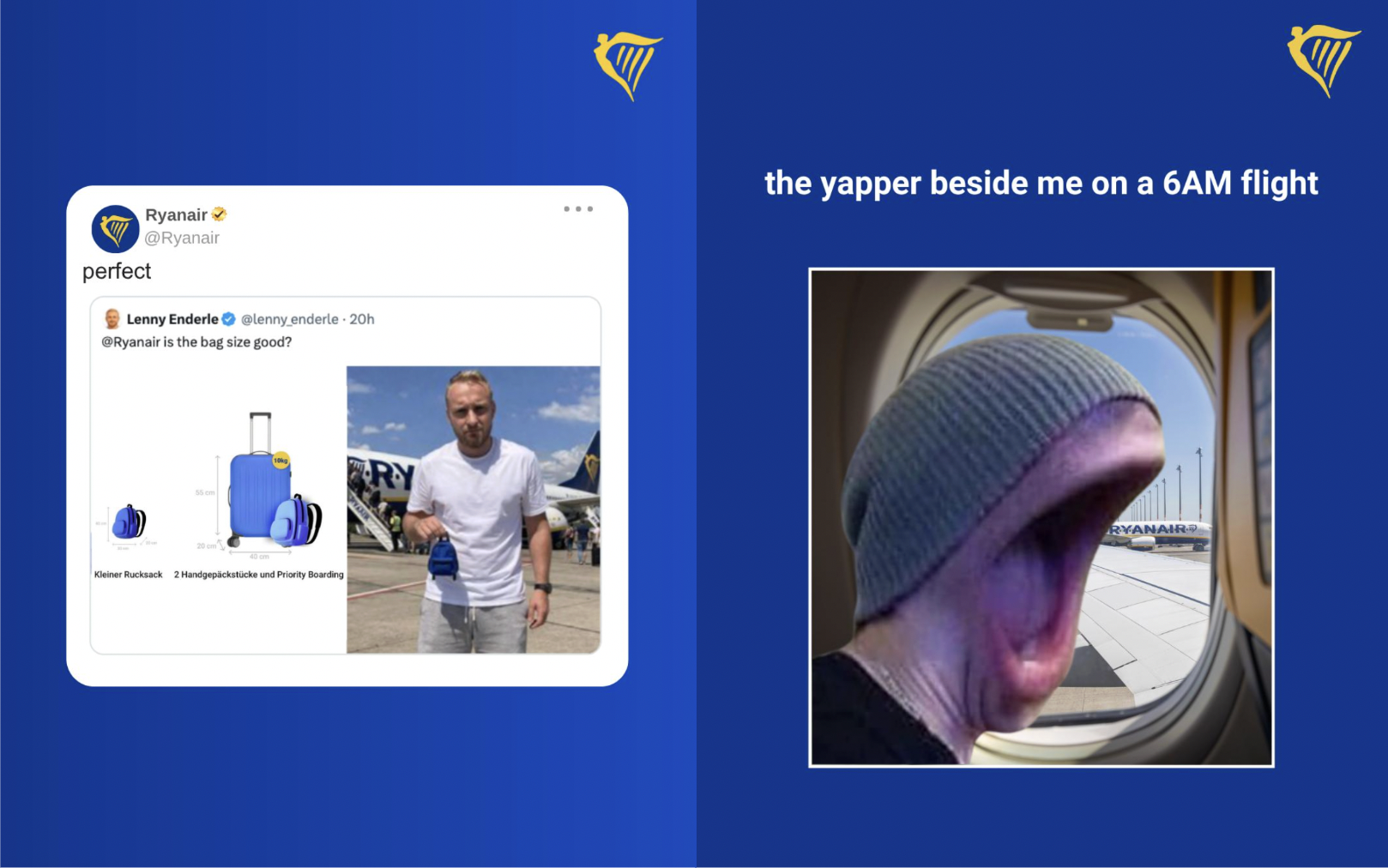
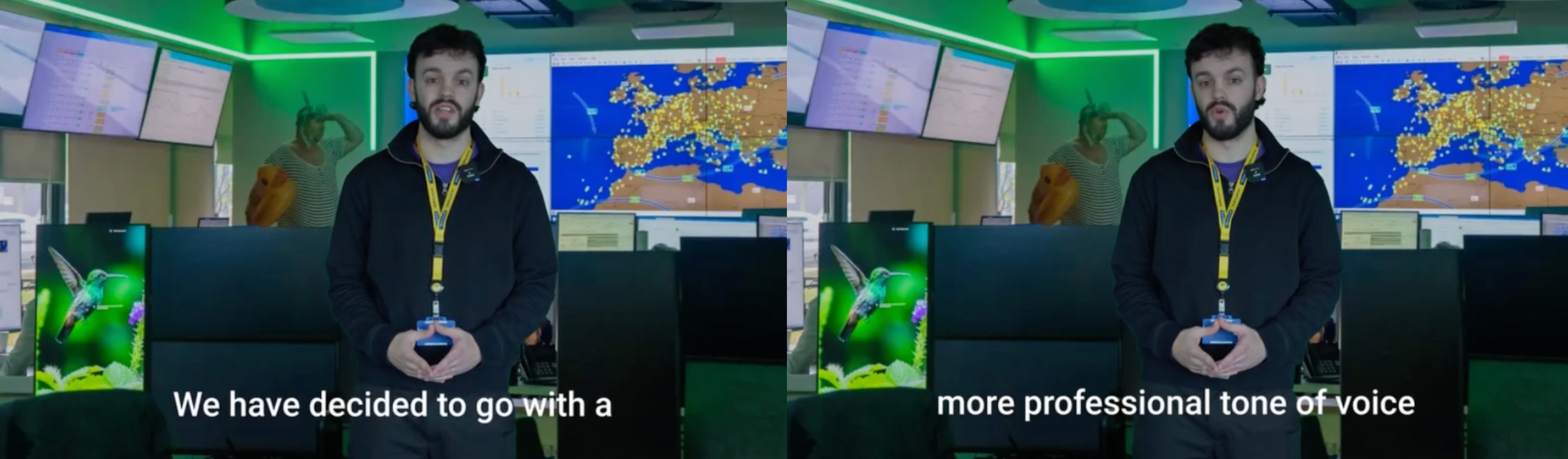
Brands, of course, have been watching. For years, the play has been simple: meme to seem human. Sometimes it works. Sometimes it really works. Ryanair, Duolingo, Wendy’s, Nutter Butter, Scrub Daddy – fluent, fast, a little feral, and frequently cited as best in class. Ryanair has built an entire tone of voice around it. This year, it even joked about going corporate for April Fool’s. No chance.
But saturation has consequences. When every brand is chasing the same joke, the same format, the same fleeting reference point, insertion alone isn’t enough. On Reddit, one user put it bluntly: “replicating memes for the sake of trying to reach is most of the time cringe. However, when a company makes a meme of itself it can be spectacular.”
The distinction matters. It’s the difference between participation and transformation. For a meme to really take hold, it needs to be an original iteration, connecting to something Laura Vent called “memetic drift” in her Stillness Mode SEED. She defines it as, “the slow transformation of cultural artefacts as they circulate, accrue resonance and mutate across time, context and audience.”
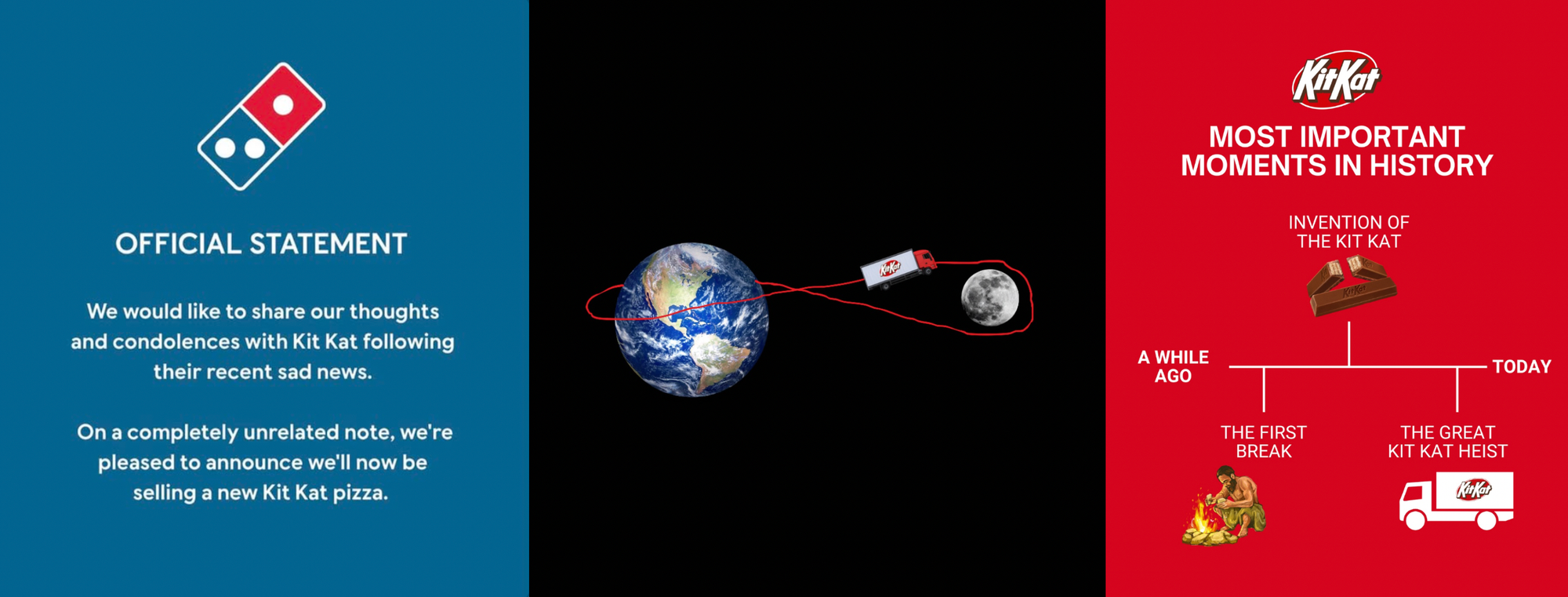
Recently, when 12 tonnes of chocolate were stolen mid-transit, KitKat didn’t panic. It leaned in. Other brands such as British Airways, KFC and (naturally) Ryanair added fuel to the fire. Dominos issued a mock “official statement”, offering condolences and launching a KitKat pizza “on a completely unrelated note”. KitKat followed with heist-movie parodies and a rewritten timeline of history featuring “The Great KitKat Heist”. A crisis reframed as content, then as culture.
Loewe also understands this tension – luxury brushing up against the absurdity of low-brow meme culture. Its TikTok is loose, occasionally unhinged and where the brand has the most fun. Under one video, a user commented, “What happened to luxury”, with another responding, “it started having a personality”.
Loewe's TikTok
GUESS Jeans uses memes differently. Shot on an iPhone 5c, blown up to billboard scale, one of its campaigns earlier this year leans into the texture of early internet image-making. Lo-fi selfies overlaid with meme-style scraps of text, somewhere between Tumblr archive and Twitter relic. It taps into another function of memes: not just humour, but comfort and nostalgia.
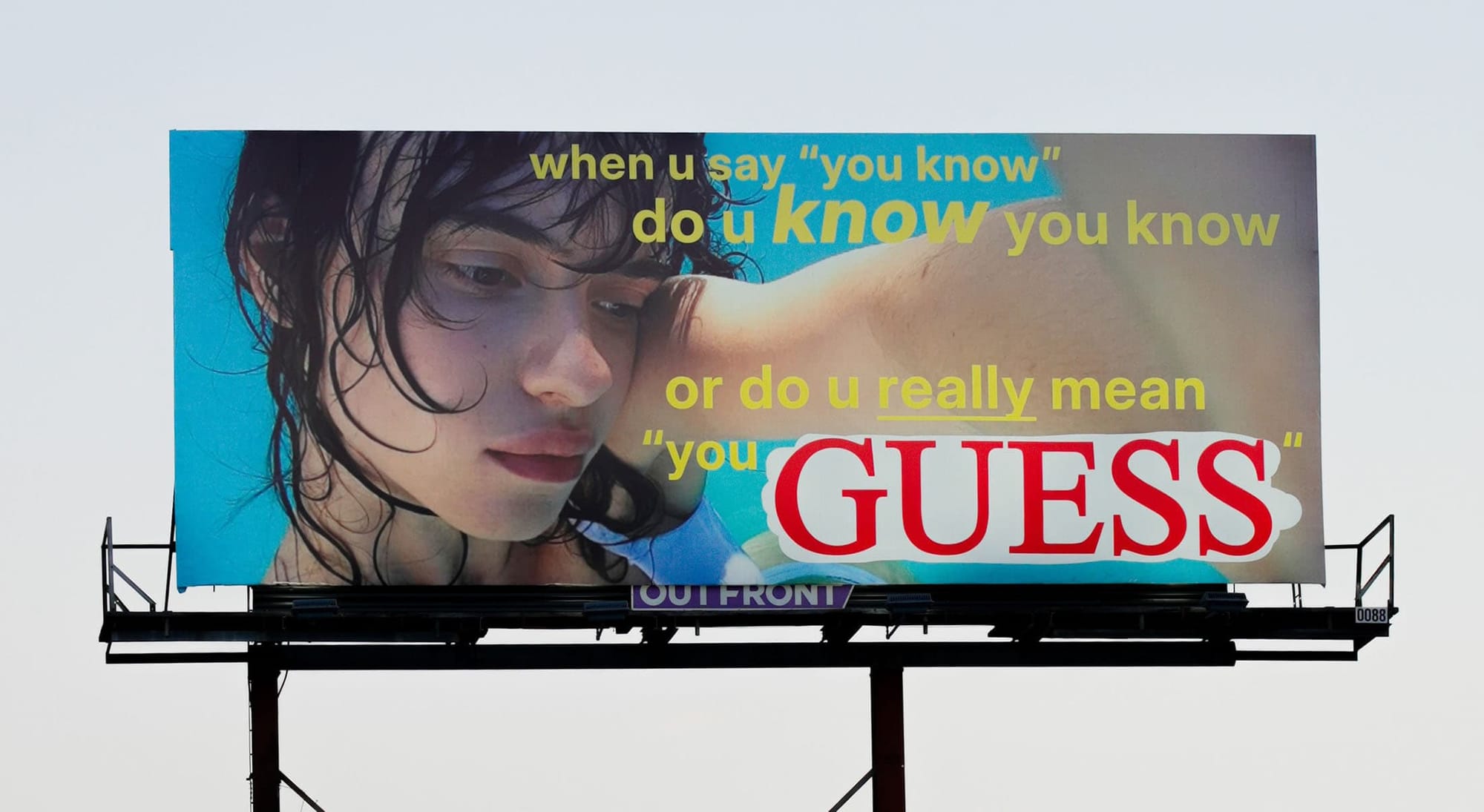
For some, the 2010s remain the golden age – a time before feeds calcified and content became industrial. TikTok’s “Great Meme Reset Of 2026” taps into that longing, calling for a return to something “dank” and less forced. As WIRED reports, the implication is clear: memes have lost something. AI-slop, algorithmic churn, brainrot, the weight of brands trying too hard – all have reduced the quality of today’s meme stock, making older memes more culturally valuable.
But memes were never meant to be stable. They began in the margins – forums, subcultures, inside jokes – and now sit at the centre of culture itself. In Meme To Brand, we asked SEED CLUB about what makes memes work for brands. “In a way, memes are a formal aspiration for brands – a means for a brand to achieve maximum self-actualisation,” says Ruba Al-Sweel, “where both early adopters and laggards are equal in spreading its prophecy.” Anna Rose Kerr is more sceptical: “Memes thrive in a culture that’s endlessly accelerating – rotting and regenerating at the same time. This is also why the format rarely works for brands. Rather than relinquishing control, brands often end up producing content in meme-like costumes.”
Even though memes are largely lighthearted, because of the rapid speed in which they spread, they’ve even become political tools for ideology, shorthand for entire worldviews. Now, the direction has flipped. And for the first time, memes are no longer something that are just born online and pepper our daily lives as funny references or silly expressions. They’re shifting internet behaviour into real-world action, with real-world consequences.
As Julián Medrano Hoyos writes in the SEED Human To Meme, “Internet memes, once reflections of ‘real life’, now themselves become what is replicated: an executive office named after a meme coin, official government accounts using memes to comment on political decisions, Wall Street trading meme stocks, crypto exchanges listing meme coins, artists creating meme-based art.”
Memes aren’t disappearing. If anything, they’re becoming ambient – less visible, more embedded. Which leaves brands in a strange position: not whether to engage, but how to exist inside something that resists control.
Our upcoming FORUM on 28th April digs into exactly that. With a panel spanning culture, strategy and the internet’s more chaotic corners, we’ll explore how memes shape meaning, how they drift and whether – in this phase of their evolution – they still matter.
| SEED | #8400 |
|---|---|
| DATE | 09.04.26 |
| PLANTED BY | PROTEIN |
