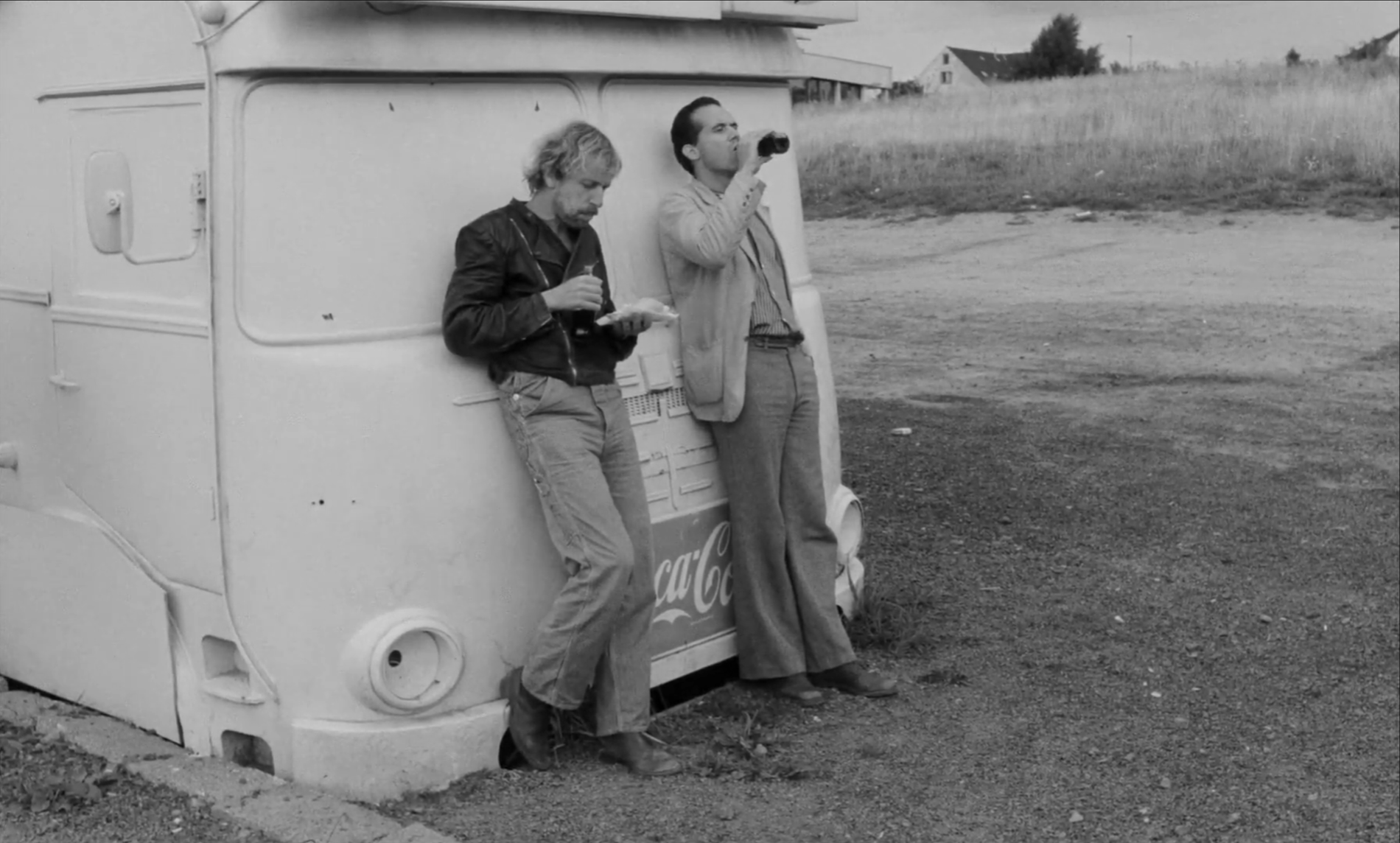
Near the end of Wim Wenders’ 1976 film Kings of the Road, two drifters, Bruno and Robert, sit in a quiet Jack Daniels haze, talking about a boy learning to read and write. The boy imagined letters moving along the notebook lines as if they were paths. Each letter had a personality; L, in particular, was “mean as she can be”. Bruno reflects on a memory of humming a tune during an argument with his girlfriend, only later realising the lyrics: “I’ve got a woman, mean as she can be.” Robert smiles suddenly: “The Yanks have colonised our subconscious!”
Bruno and Robert in Wim Wenders' Kings of the Road (1976)
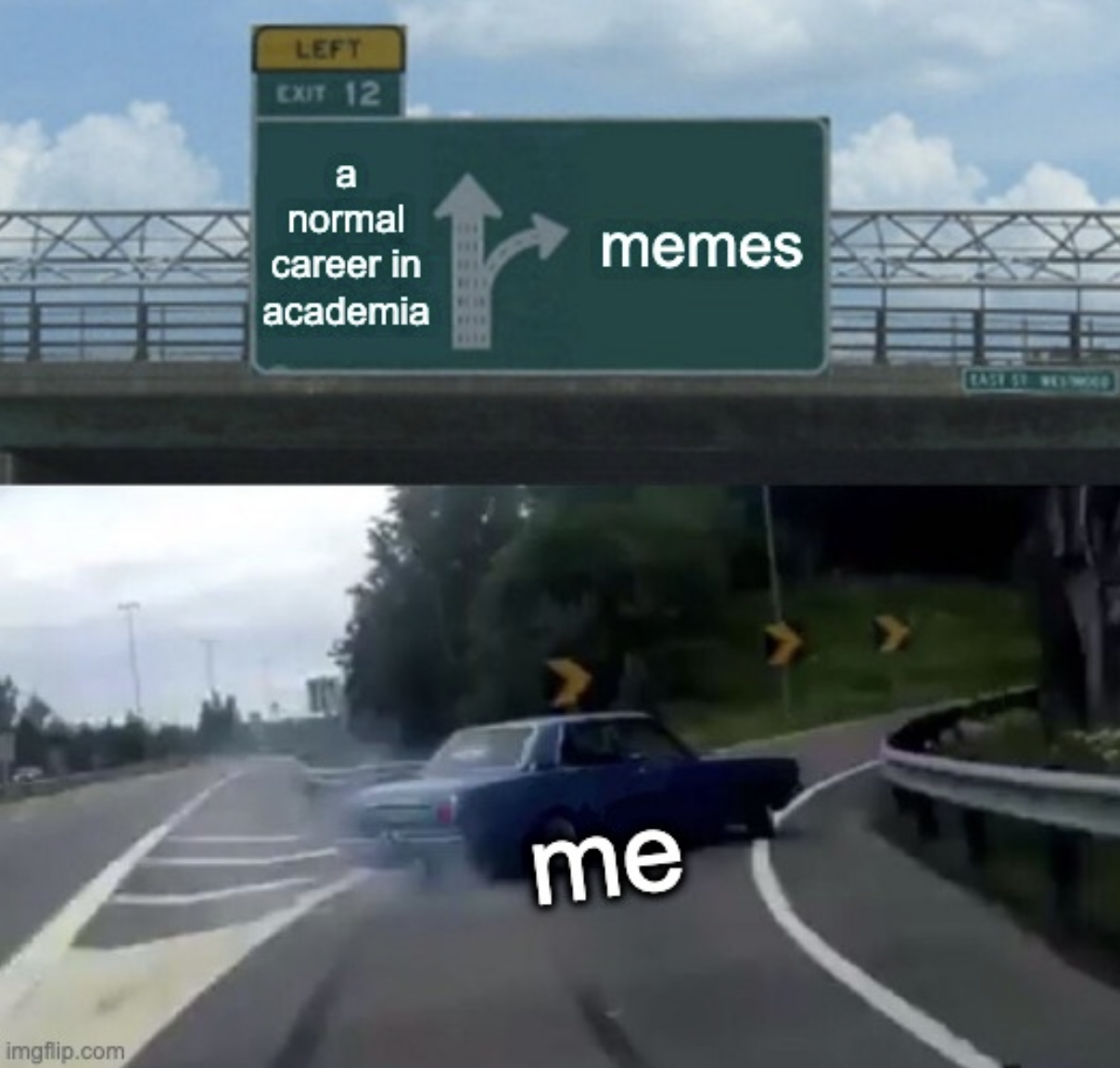
In much the same way Roy Orbison’s tune finds its way into Bruno’s mind during an argument, I recently saw a meme conquer my attention while watching a film: a car sped on a highway before taking an exit, and suddenly the Left Exit 12 Off Ramp meme appeared in my mind in all its glory. In that split second I also had the thought: memes have colonised my subconscious.
Later that day, I looked up the original video that spawned the meme to discover, confused, that not only is the driver not abruptly exiting a highway (they even use the turn signal!) but there isn’t any exit sign at all: the driver is simply leaving a freeway “like a boss,” drifting in a Fast & Furious kind of way. To add to the confusion, I found a post that tracked the exit sign to Westwood, Massachusetts, and the video to a road in Lørenskog, Norway.
So, what have we got here?
If we think of memes as units of cultural inheritance, anything that successfully replicates itself by imitation, as per Richard Dawkins’ early definition, we see the pattern clearly. A catchy tune finds its way into Bruno’s mind without him noticing, gets replicated by him humming it and becomes a meme.
The same applies to Robert’s line, which entered my mind when I first saw the film over 10 years ago and conquered my attention in a fraction of a second, even while noticing a meme do the same in the middle of a completely different movie. In a way, it feels as if I am merely a vessel for these memes, enabling their relentless replication.
Of course, there were no internet memes in 1976 when Dawkins first coined the term. Back then, a meme was mainly the imitation of human behaviours: wearing a reversed baseball cap; reenacting the zebra crossing outside Abbey Road Studios.
Today, a single still, recontextualised with a caption, sheds its original attachment and can now be adapted to a wide range of emotions and cultural events. Stripped of origin, the meme becomes context-free, an embodiment of culture: in the words of cultural theorist Matt Klein, these are “fossils of the zeitgeist: nuanced, visual, data-rich artefacts revealing social sentiment”.
As we expand our environment and explore the digital realm, we produce these virtual artefacts, which, despite being immaterial, influence the physical world through our interactions: we modify and replicate them while being transformed by them.
Now a pressing question arises: if internet memes don’t merely replicate what happens in “real life” but become artefacts in their own right – sometimes having no real-world counterpart and even defining the original event – should we still distinguish online from offline? This dichotomy understates a fundamental misunderstanding of digital culture. Klein notes that “we still primarily view online spaces as a relegated ‘Other’ – even when it has had legitimate offline consequences.” Social media theorist Nathan Jurgenson calls this the digital dualism fallacy: the idea that culture can be separated into online and offline.
Protein AGENCY provides insight, foresight and strategy for global brands that's rooted in culture and the collective knowledge of SEED CLUB - our decentralised research community of 450+ global experts.