There’s control to be found in the chaos of the cosmos.
Evil Astrology – Rina Nicolae
If you’re anything like me, you’ve taken screenshots of your birth chart and current transits, uploaded them to ChatGPT and asked for a detailed interpretation. Maybe you’ve paused taking action – holding off from sending that fateful text – until the stars inform you it's the right time to do so.
Contemporary astrology is personalised, interactive, socially networked and increasingly integrated into everyday life. According to a 2024 Pew survey, 27% of US adults believe in astrology, a figure that rises to 43% among women under 50.
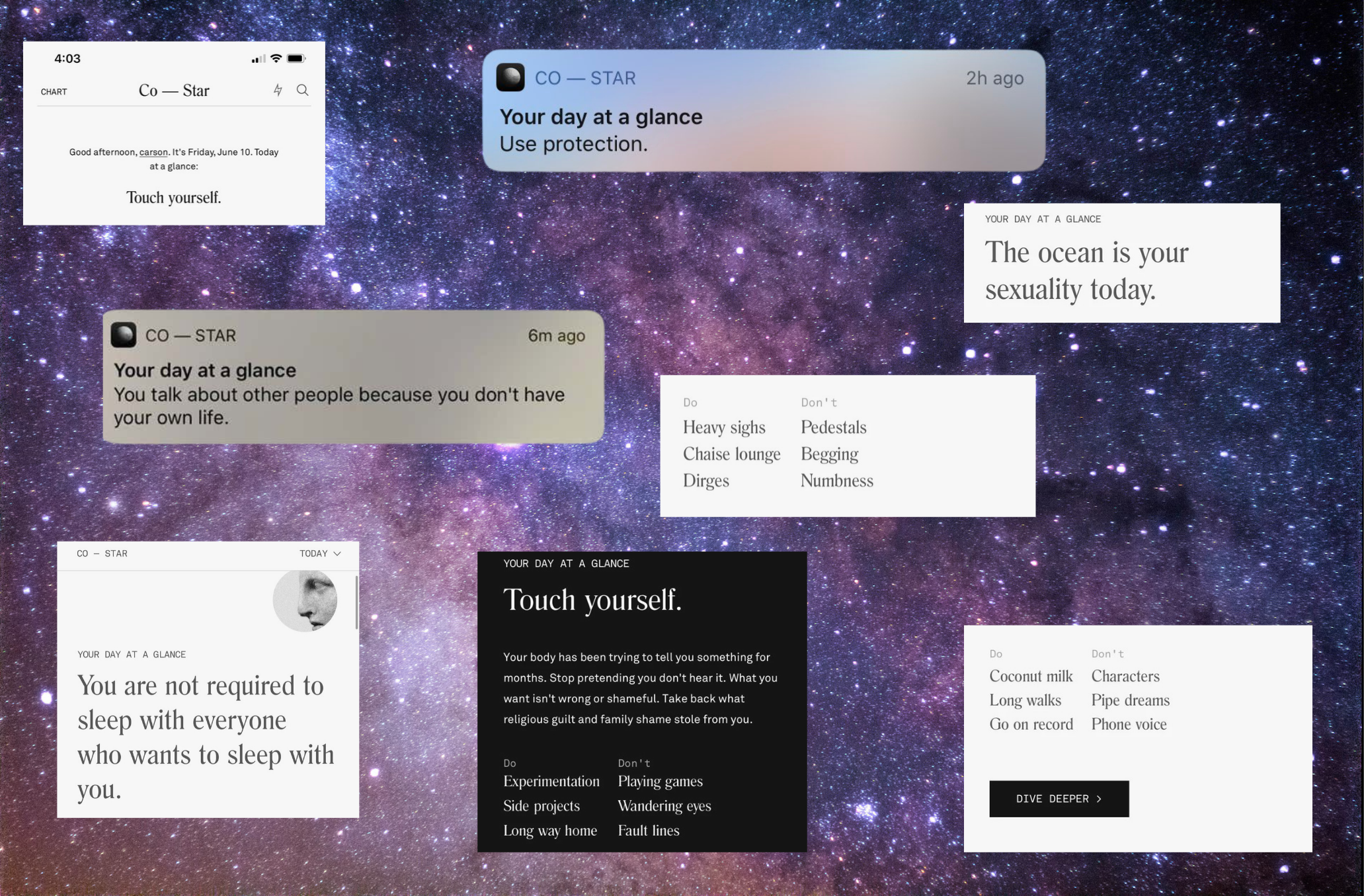
This burgeoning belief was reflected in Midjourney, the AI text-to-image company, acquiring astrology app Co–Star in July 2026. At the time, Co–Star had 4.3 million monthly active users. Not only does this purchase underline the huge, mainstream interest in astrology, but is emblematic of the corporatisation of it.
The move by Midjourney is apparently part of a larger strategy to map the entirety of the human experience, which occurs at a time of heightened existential anxiety; what it means to be human – our intelligence, suffering and pleasure – interrogated and diminished at the same time.
The wisdom of Co–Star
Founded in 1999, Keen started life as a fee-based online advice platform, before evolving to specialise in spiritual and metaphysical services. Earlier this year they launched their new brand identity, created by Mother Design, further signalling the growing relationship between technology and wellness, and the serious business of digital spirituality.
Why, as our technological capacity to predict the future becomes increasingly sophisticated, are we turning to ancient systems to help us navigate it?
There’s a difference between prediction and understanding. Just because my Spotify algorithm can consistently recommend music I like doesn’t mean it understands me. Rather, it classifies me into carefully coded pens. But long before algorithms were categorising us, we were doing it to ourselves through systems like Myers-Briggs, Human Design, the Enneagram, Kibbe body types, seasonal colour analysis, and even starter-pack memes.
These frameworks make the world easier to digest and interpret, reducing its complexity into a select number of positions we can put ourselves in. In doing so, they also situate us in relation to others, whose own position provides us with further information to measure ourselves against. With this conceptual scaffolding in place, we orientate our experiences, our actions and ourselves.
Protein AGENCY provides insight, foresight and strategy for global brands that's rooted in culture and the collective knowledge of SEED CLUB - our decentralised research community of 500+ global experts.