

Broken Production

A death linked to a Kartik Research scouting trip exposes a fashion industry driven by fast imagery, where the demand for “real” production is outpacing the systems meant to support it.

Kartik Research has, in a pretty short space of time, become one of the most closely watched contemporary menswear labels emerging out of India. Founded by Kartik Kumra in 2021, the brand now operates between New Delhi and New York, with global industry recognition that includes two LVMH Prize semi-finalist listings.
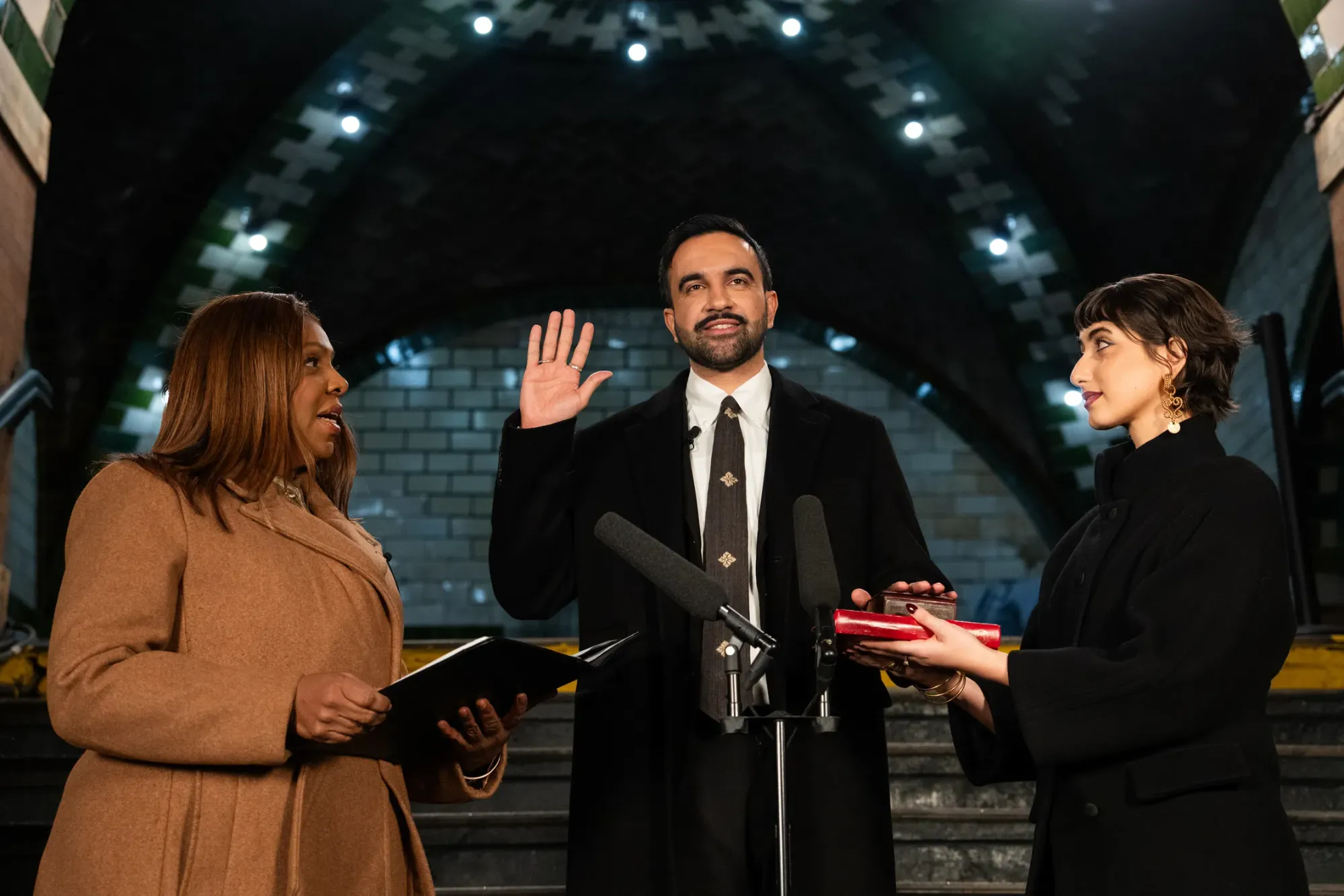
It has also collaborated with fashion media platforms including the podcast Throwing Fits. In January, a Kartik Research tie appeared on Zohran Mamdani at his inauguration in New York – a detail that widely circulated online as another marker of the brand’s growing visibility.
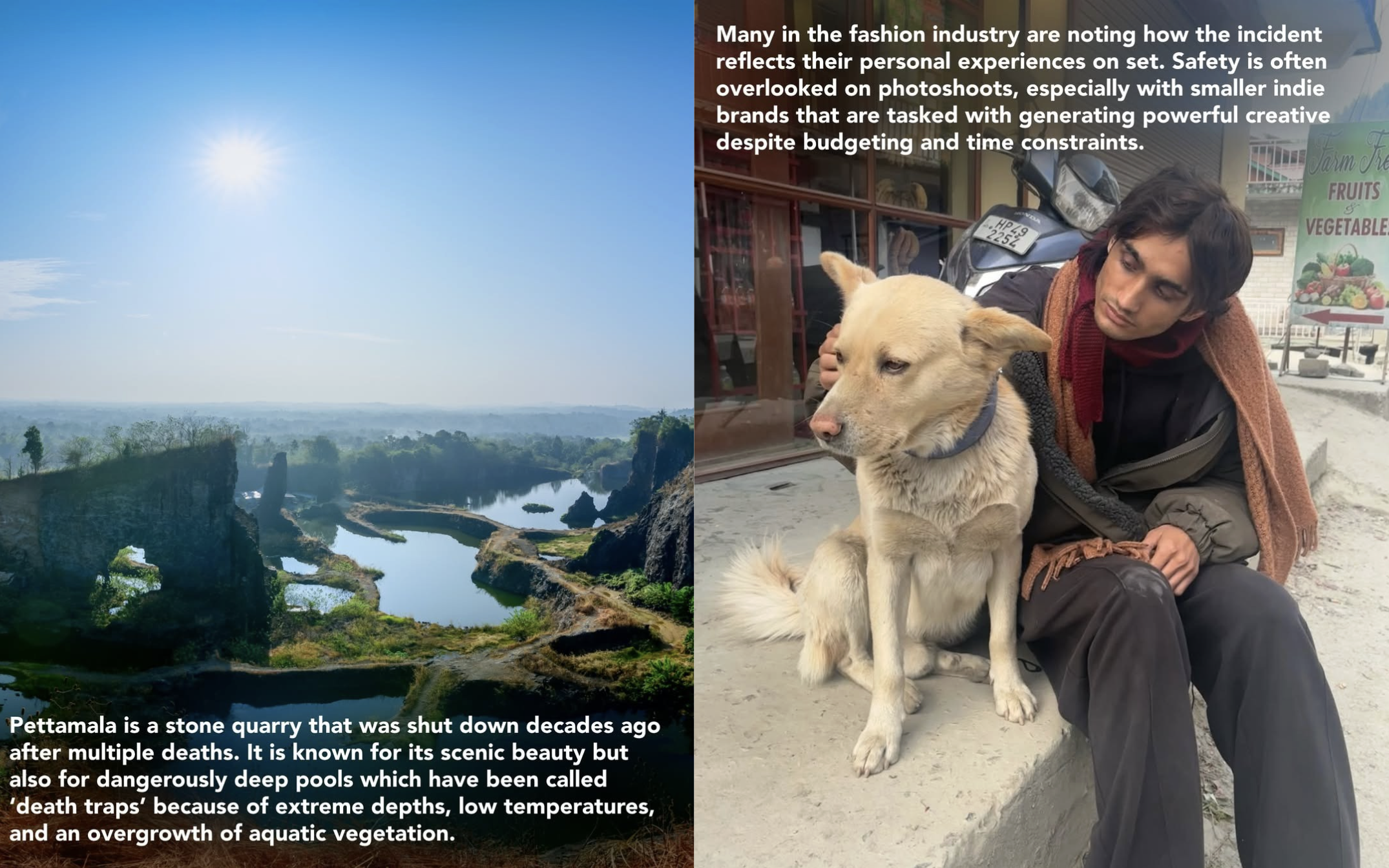
That momentum was recently overshadowed by tragedy. On May 28th, 26-year-old Divyanshu Joshi, who worked with the brand, died in Kerala during a location scouting exercise for an upcoming shoot. According to reporting from The Voice of Fashion, The Times of India and The Hindustan Times, Joshi had travelled with the Kartik Research team for production work in Kochi. After a shoot at a local theatre, the group moved north of the city for a recce at an abandoned stone quarry, described by Diet Prada as a site known for its “scenic beauty but also dangerously deep pools,” often referred to locally as “death traps” due to low temperatures and dense “aquatic vegetation”.
It was here that Joshi entered the water and drowned. The site, inactive for more than two decades and not open to the public, is now under police investigation. In a statement posted on Instagram on May 31st, Kartik Research said Joshi was “deeply loved by his team,” emphasising his role within the Delhi store and asking for privacy. The brand also stated that swimming was not part of any planned production activity.
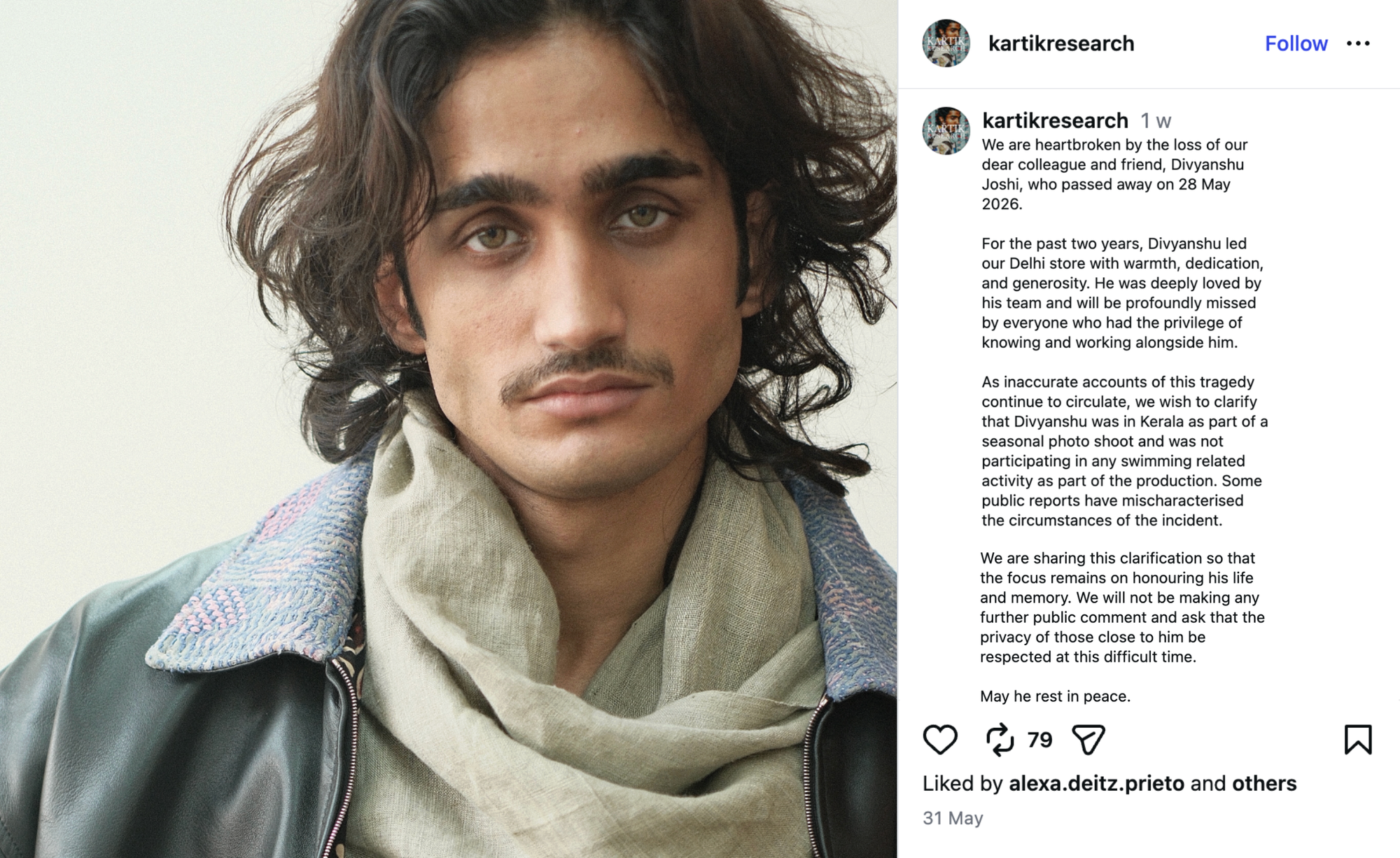
Joshi wasn’t peripheral to the brand’s world – he was embedded in it. For two years, he managed Kartik Research’s Delhi retail store while also appearing in shoots, reflecting a broader structure common in smaller, fast-growing fashion labels where retail, production and creative roles often overlap.
In the creator era, there’s barely any space left between the spark and the thing itself. Timelines have tightened, budgets have shrunk, AI has entered the room. What used to take weeks of slow build now unfolds in double time, as production absorbs its own momentum. Brands want cinema, but they want it at the speed of a scroll. The gap between vision and execution thins, until even risk sits uncomfortably close to the brief.
Kartik Research sits inside this shift. What began in India as a tightly networked creative practice has expanded into a transnational brand with growing visibility. This is often described as “organic growth”, but in practice it means acceleration: more briefs, more locations, more pressure to deliver realism at pace.
Fashion imagery increasingly depends on the appearance of access – to real places, real textures, real life. Location itself becomes part of the aesthetic. Remote or difficult terrain carries cultural value; effort is read as authenticity. The image matters, but so does the sense that it had to be physically earned.
That tension has only sharpened as AI-generated imagery becomes more seamless and widespread. The more easily images can be simulated, the more value is placed on proof of physical presence – being there, going there, accessing what feels out of reach.
The recce – the process of assessing locations before production – sits outside the visible output but determines much of what is eventually seen. In larger corporate environments, it is governed by formal safety systems; in smaller or independent setups, those structures are less consistent.
Behind every image that reads as effortless sits an infrastructure that rarely appears in frame: scouts, fixers, drivers, assistants, freelance crews. Their labour underpins the final image and yet it remains largely invisible. What remains under examination is not only what happened in Kerala, but the system around it. As Diet Prada noted, safety is often deprioritised on smaller shoots under pressure to deliver quickly, with individuals absorbing risk as part of the process.
But this sits within a wider shift across the creator economy: more images being made, more quickly, across increasingly unstable conditions. AI can now generate visuals, references and entire worlds in seconds, yet that hasn’t slowed demand for “real” production – if anything, it has raised the stakes on it.
The result is a culture where speed is default, friction is assumed to have been solved and the labour that makes images possible is pushed further out of view. What this exposes is not just a single incident, but a production system running faster than the safeguards designed to hold it.
| SEED | #8417 |
|---|---|
| DATE | 09.06.26 |
| PLANTED BY | PROTEIN |
