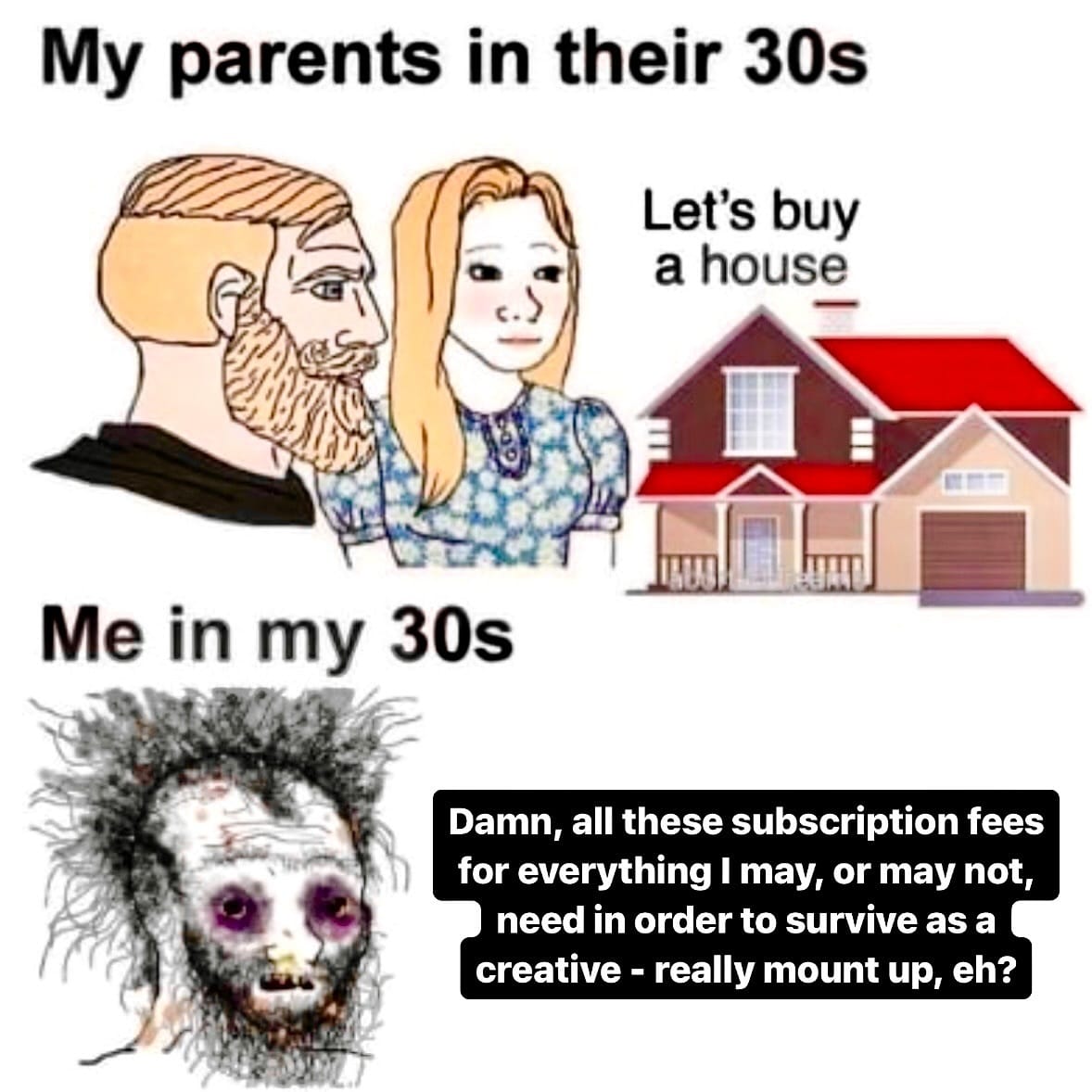
Dank Art Director is the anonymous art director behind the popular Instagram meme account of the same name, operating at the intersection of fashion, design, internet culture and chaos. Over the past nine years, he’s built a practice out of watching – and warping – how memes move, mutate and mean (or increasingly don’t mean) anything at all.

This interview lands just ahead of our next online FORUM this week, on Wednesday 29th April, which will ask whether memes still matter today — pressure-testing meme culture as it exists right now, how it’s reshaping culture in real time and whether brands should be anywhere near it at all.


Protein: Which, if any, memes have stood the test of time?

Dank Art Director: Because memes are disposable, people don’t attach much depth to them, but they’re always based on something true and are nearly always revealing something. There are some that are really perennial and come back every year because things, sadly, don’t change. It’s like a design choice. I suppose good design just works. We’re still using Swiss grids in graphic design because they just work, and I think there’s maybe some very trite, weird parallel between good design and meme culture. Like the meme of the distracted boyfriend – we didn’t have that before a certain period, but once it came in, it was there to stay. We don’t need to improve on the Drake ones. They will work again and again and again.

Most of the time I don’t know where the original images come from and they’re all repurposed. I’m an art director by trade, so my job is making pictures, but I don’t think I could come up with these images myself. I’d overthink it.

There’s probably a Champions League of memes, and I think there’s a bunch that have phased out.

Protein: We’re in what some people are calling the “brain rot era” of memes – chaotic, nonsensical, absurdist. Do you think memes have lost meaning, or just changed how meaning works?

Dank Art Director: I think we’ve obviously oversaturated memes and they probably don’t mean anything. I think this generation of young people are chronically online and on their phones, and the fried memes are a perfect mirror to their understanding of the world. There’s no depth, I guess. And I’m sure there are very smart kids, but I think in mass this brainrot era is the result of a sloppy approach to internet usage and consuming content. It’s like Charlie Brooker’s Black Mirror.

So much of internet culture nowadays seems to be about being offensive, and it’s all manosphere-adjacent. It’s all about rating or berating each other. And it’s not actually funny. It feels like the changing rooms in Year 9, but now it’s just on the internet.

Protein: Do you think memes are something we should take seriously? And what do they reveal about the state of culture?

Dank Art Director: The problem with memes is their success and their failure is the same problem – they’re very face value. They’re meant to be face value. For success, you just have to see it and share it; it’s a gut thing. It has to be relevant.

I get a bit of a gut feeling about which ones will work and which won’t. Some days I’ll do one and don’t care if it gets 136 likes. But I will let one flop if it makes me feel like I’ve said something and unburdened my brain. But if it’s not a format or a picture or a gratifying visual, it won’t work.

That’s the problem with memes. You have to tie it to something that feeds a different part of your brain at the same time. It’s almost two scratches at once, or two frequencies at once. You have to please the aesthetic, which deep fried memes don’t – they don’t actually resonate. Memes only work as a valuable asset if people are engaging with them sincerely. But at the same time, what a silly format to actually try and lead change as well.

Protein: In just a few hours, a meme can become irrelevant. How do you decide what’s worth posting and what stays in the drafts?

Dank Art Director: When you see something so memeable, the only worry is: are you quick enough? It can’t be something that’s been around for three days. It’s got to be day one of it still kicking off, but then you run the risk of getting lost in the sea of algorithms.

I’ve got a very decent organic follower count, but because of how the algorithm now works – where it drip-feeds even to those who have chosen to follow this stupid page – if the first meme doesn’t hit the first hundred people, other people won’t get it in their feeds. So you almost have to move to a subscriber model.

I’ve still got some in my iPhone Notes that I’ve never really covered. They’re like micro-transactions and micro-moments in the industry. But then you’ve got to wait for the perfect picture. I could go a bit more obscure for my own enjoyment and alienate a good 60% of the audience immediately. But there has to be a marriage between words and image, so some I just let die in my Notes app.

Protein: Have you noticed memes evolving to serve the algorithm?

Dank Art Director: I feel like to cut through on platforms like TikTok, you have to post the same thing seven times and just hope it hits. It’s like the person in the room desperately saying a punchline for everyone to hear. It feels a bit David Brent. I’d rather be the one saying one twatty little one-liner and hoping six people actually heard it.

It’s funny to make lots of gags and let some miss. I guess I’m not really afraid of failure. I don’t really care.

Protein: Some of the most powerful memes today are accidental. Can you still “design” a meme, or is that idea fundamentally broken now?

Dank Art Director: There are ones I’ve laboured over, and you can tell. Anything I do too well really flops. I can make the same point in two visual ways – one in Photoshop, more clean and tidy, and one on your iPhone, as quick as humanly possible, saved to camera roll and cropped. The shitter one will always do better. I think anything you’ve laboured over just doesn’t do as well. To be a zinger it has to have that zing, and a zing is definitely something immediate – you have to be very immediate.

But you also can be too early. When you talk about something we haven’t got to grips with yet, it just feels too soon. And because memes are by and large a pop culture product, if people aren’t talking about it yet, it won’t land. So well done, you knew about it first, but that’s just arsehole Pitchfork behaviour – and I’ve done that. It’s got to already be embedded in the public, and then the meme drops at just the right time.

Protein: Do you think brands can genuinely participate in meme culture?

Dank Art Director: No! It’s not for them. It shouldn’t be. It’s not their place. It’s so disingenuous and a bit icky. It’s like your boss coming to work drinks. You can have cool ones, and they can come once or twice a year, and you’re picking up the bill because that’s nice – and that’s treating your workers right – but don’t come every time. Leave the kids to do their thing.

Brands don’t need to try and insert themselves into every situation. And brands who do are like David Brent again: “I’ll get a round in.” “What are we talking about?” “What football team do you support?” I’m making myself cringe even trying to describe it. But it doesn’t seem to bother young people as much because they can’t imagine a world that’s uncommercialised.

Protein: After nine years of memes, why did you decide to also start a Substack?

Dank Art Director: Because it’s hard being funny. A lot of my memes don’t work if I don’t have a caption. They’re just streams of consciousness – intentionally bad grammar, intentionally long multi-hyphenated words and brackets and side notes that explain the picture again or propose a scenario going on in the image. Sometimes I’d rather just write the caption and not need to find the picture. But on Substack you have to have an article image, so I still end up almost having to make a meme after I’ve just written 2,000 words anyway. Writing also helps you form your actual opinion on something.

Protein: Do you think memes are something we should take seriously? What do they reveal to us?

Dank Art Director: I think memes are a mentality and the medium is the picture – as well as “the medium is the message”, Marshall McLuhan, all that shite. My account started off as one thing and it still should be mostly just silly pictures, but for me it’s become a much more valuable tool in understanding what I think about the world. So to me it’s more like a magazine, and I think if I ever changed it, I would turn it into a zine or magazine and start featuring writers.

Since day one I don’t sit there to be an edgelord. Maybe it’s because the job I’ve fallen in love with is a job I know has been wrong from the start. I love a bad thing, so I have to make sure I tell everyone I know it’s bad to keep myself pure of mind.

I think the interesting crux is that the world has gotten a lot worse since I started this. So this didn’t mean anything when it started seven years ago – it was just a secret Instagram account at work. Then it got bigger. Then I unlocked it at 300 people.

That was when I was just talking about working for a slightly nuts fashion person, and now it’s completely relevant to Bezos and the AI-ification of the industry at large. I didn’t expect to still be here.

Protein: What do you think the next era of memes will be defined by?

Dank Art Director: It can’t be more of the brain rot stuff. I guess maybe more back to text-based. And then my thing is: if they’re text-based and not visual, you may as well just write something – and if you’re writing something, you may as well actually write something properly. So I’m almost hoping we get this out of our system.

Basically, I’m hoping memes bloom into a movement. I hope it’s like an art movement that then informs the next. But it won’t be that we’re looking at things that even feel like memes – it will move into action. It will move into journalistic careers. It will move into teachers.

Memes should already feel passé. Why are we still doing them? If it’s just to be funny, let’s go back to actual comedy. The funny people should start writing comedy again because the UK is in dire need of an actual comedy industry.

SEED #8405
DATE 28.04.26
PLANTED BY PROTEIN