Cultural fluency can’t be fast-tracked – even with a World Cup on the horizon.
When Morocco reached the semi-finals at Qatar 2022, every Arab person I knew – wherever they were in the world – lost their mind. Beyond the headlines and the euphoria, it felt like something else too: a rupture. A chance to rewrite what brands think this market is worth, and to shift how we’re seen globally. The 2030 World Cup hosting bid, co-shared with Spain and Portugal, followed soon after. Suddenly, every brand with a SWANA (South West Asia and North Africa) strategy had a story to tell about North Africa – many of them for the first time. The speed of that narrative shift exposed how reactive most engagement had been, built for moments rather than maintained between them.
Kit deals are the most visible layer. But the brands that are genuinely embedded show up elsewhere: in retail environments, in grassroots partnerships, in street-level pricing. The kind of quieter, unglamorous work that rarely makes headlines between tournaments. As I wrote recently about Egypt on my Substack, adidas understood early that the Egyptian market needed accessibility as much as aspiration. It didn’t win that market through kit design. It won it through decades of consistent retail presence and democratic pricing that made the brand attainable for working-class communities long before the market was commercially “interesting”. That kind of consistency builds cultural equity that can’t be switched on in a tournament cycle.
That’s what real embeddedness looks like. It doesn’t announce itself in a kit launch. AFCON 2025 – held in Morocco this January – made that distinction clear, revealing who has been doing the deeper work, and who hasn’t. Right now, three very different strategies are playing out in real time.
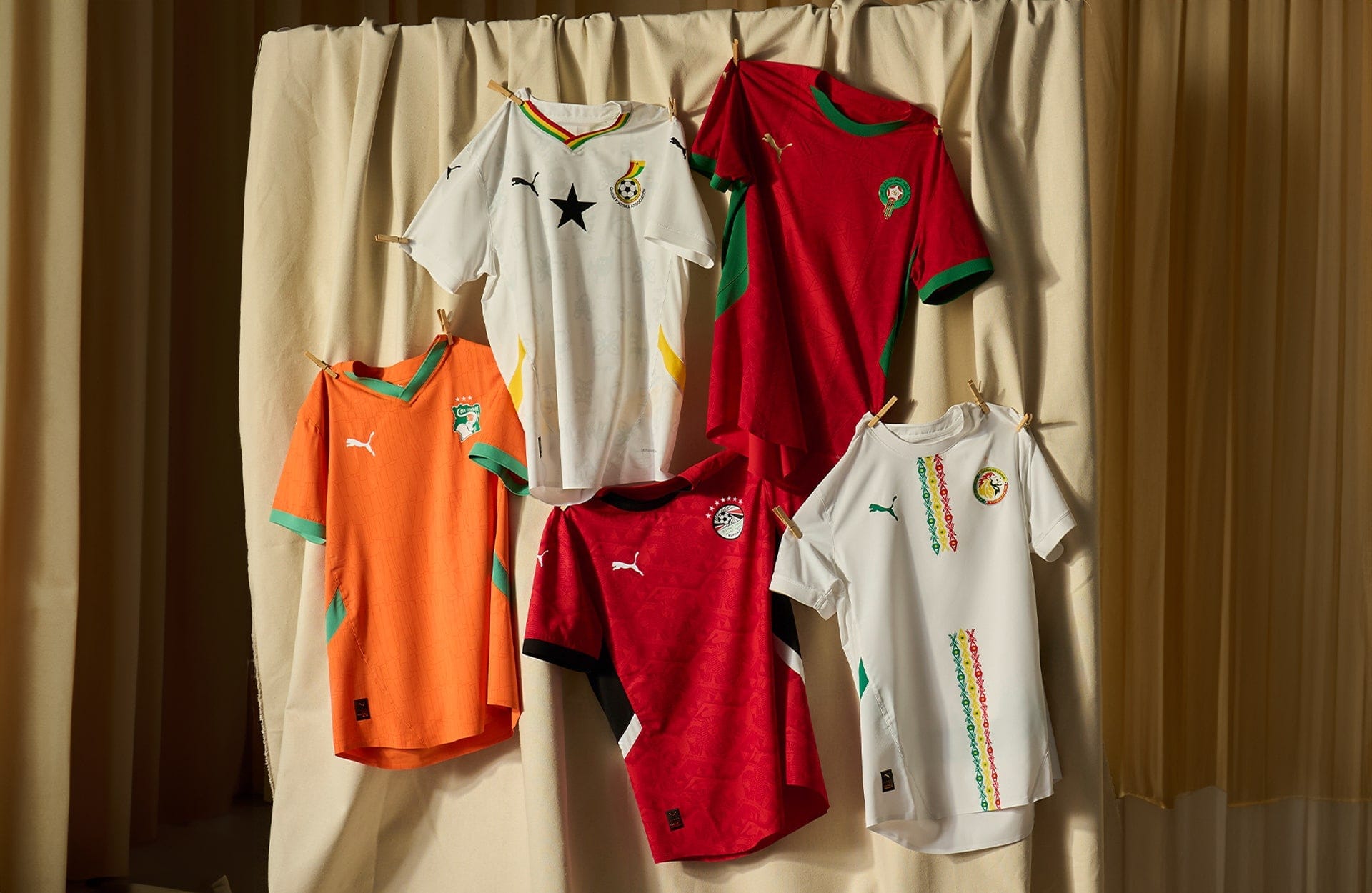
Puma holds Morocco, Egypt, Senegal and Ghana, and its work with Morocco in particular shows what sustained cultural investment can look like. The AFCON 2025 collection was designed with Moroccan-Dutch artist Abderrahmane Trabsini, weaving in Zellige tilework patterns and, for the first time on a national kit, Amazigh language and Berber rug motifs.
Morocco's AFCON 2025 kit
The 2026 World Cup kit, released last month, builds on that same visual language: traditional Moroccan embroidery on the collar and cuffs, geometric patterns drawn from local craftsmanship on the away shirt. But just as telling was the launch. Puma launched the collection not in a stadium or a showroom, but at a block party in Brooklyn’s Domino Square, where locals from each of the 11 represented nations wore its kits. Taking Morocco to the diaspora first wasn’t incidental – it reads as the result of years of attention, not a reaction to a moment. Morocco 2030 isn’t the starting point; it’s the payoff.
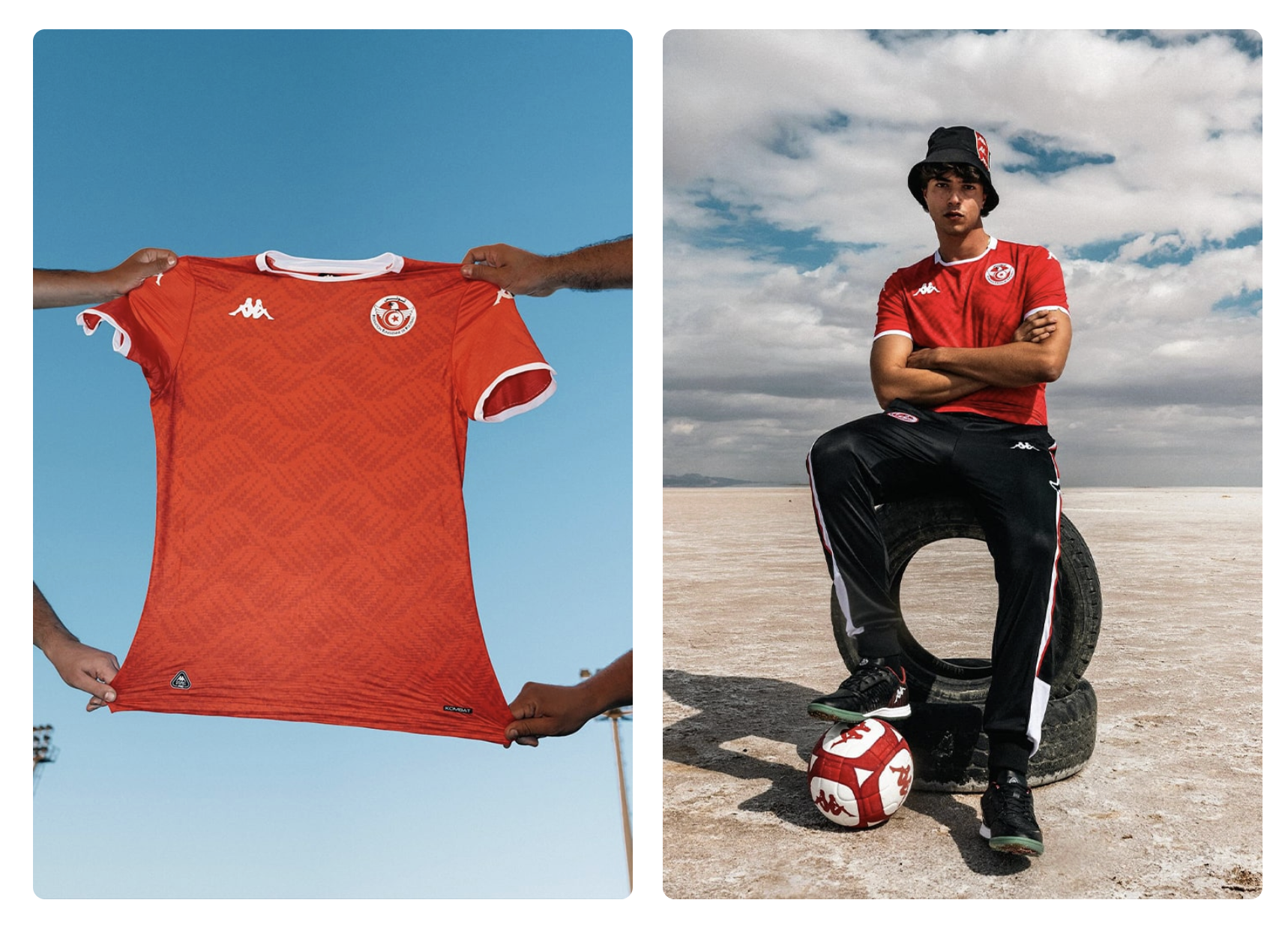
Kappa’s relationship with Tunisia tells a quieter version of the same story. Since 2019, largely under the radar, the brand has been producing kits that treat Tunisian identity as a design system rather than a colour palette. The AFCON 2025 collection centred three kits around three distinct landscapes – the Mediterranean coast, traditional carpet weaving, the Sahara. Kappa might be globally coded as 1990s nostalgia, but in Tunisia, it’s doing some of the most culturally specific work on the continent. Depth here comes from specificity, not scale.
Tunisia's AFCON 2025 kit
Adidas’s relationship with North Africa is more complicated. The brand built something deeply embedded in Egypt through infrastructure and longevity, but embedded doesn’t always mean culturally invested. Its Morocco kits between 2012 and 2019 were widely criticised for feeling generic. Algeria’s AFCON 2025 kit drew beautifully from the karakou – one of the country’s most recognisable garments – but Algeria didn’t qualify for 2026. What’s striking is that adidas still holds the official FIFA partnership through 2030: the match ball, the tournament branding, the broadcast boards. They’ll be the most visible brand at a World Cup hosted by a country whose kit they lost to Puma in 2019. Visibility without care starts to look like its own kind of absence. Infrastructure can secure presence, but not necessarily meaning.
Then there’s Nike. The world’s largest sportswear brand has no national team partnerships across North Africa or the Arab world – not Morocco, Egypt, Algeria or Tunisia. Its African football strategy effectively begins and ends with Nigeria.
Protein AGENCY provides insight, foresight and strategy for global brands that's rooted in culture and the collective knowledge of SEED CLUB - our decentralised research community of 450+ global experts.