

Reset To Real

Analogue is becoming a form of resistance, but when disconnection becomes a status symbol, who actually gets to log off?

Born in the late 1990s, I’ve watched the internet shapeshift in real time. It started as a raw tool for peer connection, evolved into an influencer-driven stage for performance, and has now become an AI-saturated landscape where speed dictates culture and virality outweighs meaning.
As synthetic content floods our feeds, the question shifts from what’s trending to what’s trustworthy.
Recently, online influencers and media outlets have started calling 2026 “the year of analogue”. The phrase circulates online – a paradox that perfectly captures the tension of the moment. The message is about disconnection; the medium is still very much the feed.
One unexpected outcome of this shift is the resurgence of analogue and tactile media not as nostalgia, but as infrastructure for meaning, trust and identity. A consequence of an over-digitised world that leads many people to feel burnout, as digital systems optimise for speed, scale and automation, shortening our attention span to a point where many of us can only watch movies with subtitles on.
There’s rebellion in this, too. As companies such as Amazon quietly remind us that we don’t actually own most of what we buy online, physical formats start to look more radical. Tactile media introduces friction, materiality and intention – qualities increasingly valued by young people and smart brands alike.
It would be naive not to acknowledge that the first digital shift also turned real-life connection into performance. It marked the beginning of the systemic curation of everyday life for pictures and videos. The 2012-2013 Tumblr era was also filled with an analogue fascination, but it was much more nostalgic, with the use of analogue filters and vinyl collected “for the vibes” and the romanticisation of being an “old soul”.
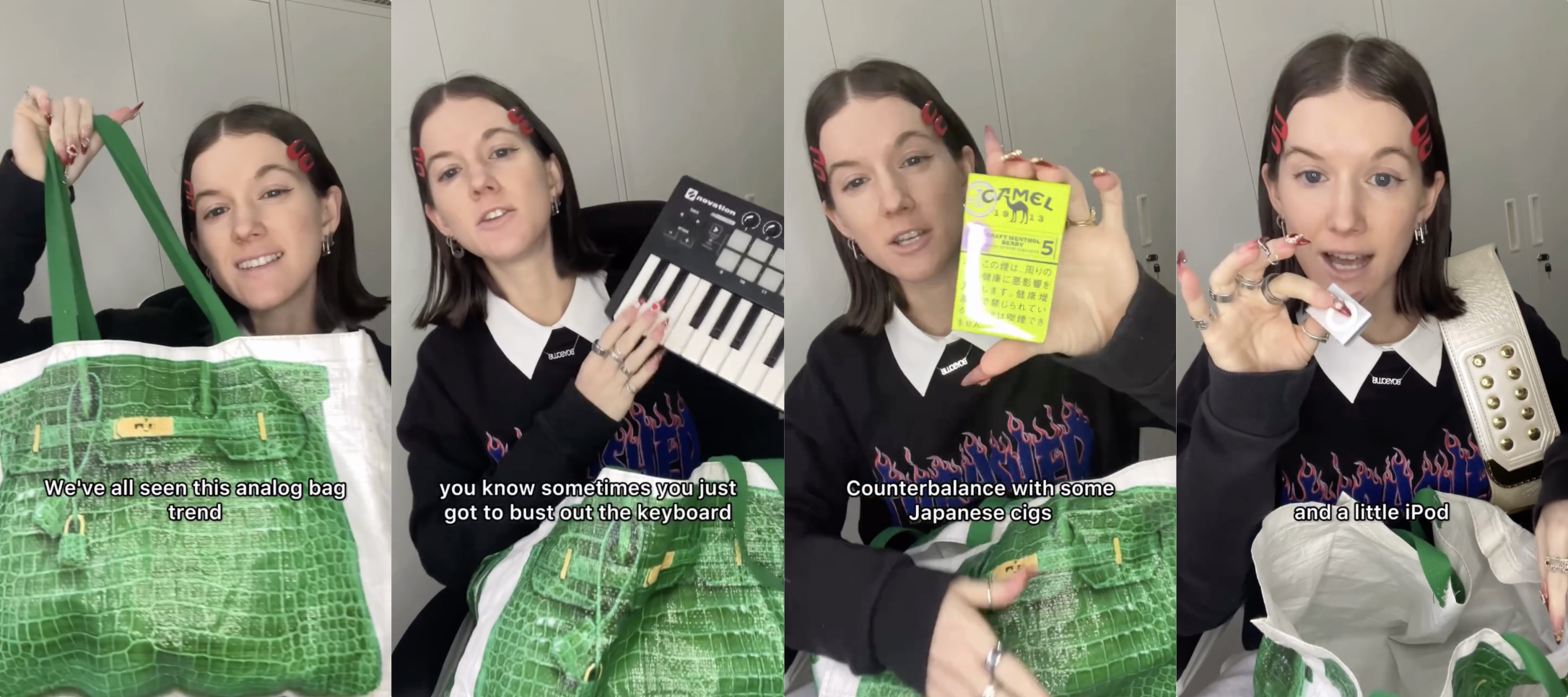
The new shift takes it a step further, driving trends like “analogue bags” and “arts and crafts dinner parties,” which convey a moment of disconnection that eventually makes its way onto social media. The transition from offline to online, although unspoken, is made clear from the start through Pinterest-perfect decorations, curated to make photos and videos of the night visually interesting and optimised for social media algorithms.
And the illusion doesn’t stop there. A psychologist friend recently mentioned that even in her very offline practice, the only reliable way to attract clients now is through building an online brand. Scroll long enough and you’ll see it everywhere: doctors, salespeople and other professions that once existed entirely IRL are now competing in the attention economy.
Eugene Healey recently shared a video titled “The Analogue Delusion”. In it, he referenced a Vogue Business article that framed unplugging as the new “luxury currency”, alongside The New Yorker’s widely-shared essay claiming “it’s cool to have no followers now”. The New Yorker made explicit what the other two pieces didn’t: that the uncomfortable truth beneath the analogue theory is that “things are status symbols because they are inaccessible to the majority of the population,” and that professional visibility and online presence are “a survival strategy”.
Privilege is often not made explicit in the media. Instead, you’ll see articles about how the new listening bar targeted at the wealthy portion of the population in your local city is the new “it-place”, or how brands such as Heineken and Bodega are partnering on campaigns to create a limited edition “boring phone” inspired by the “dumb phone trend”: narratives that frequently exclude the reality of a large portion of the population who can hardly make their phone payments on time, despite having a four-hour commute while still having to perform online for a minimum-wage job.
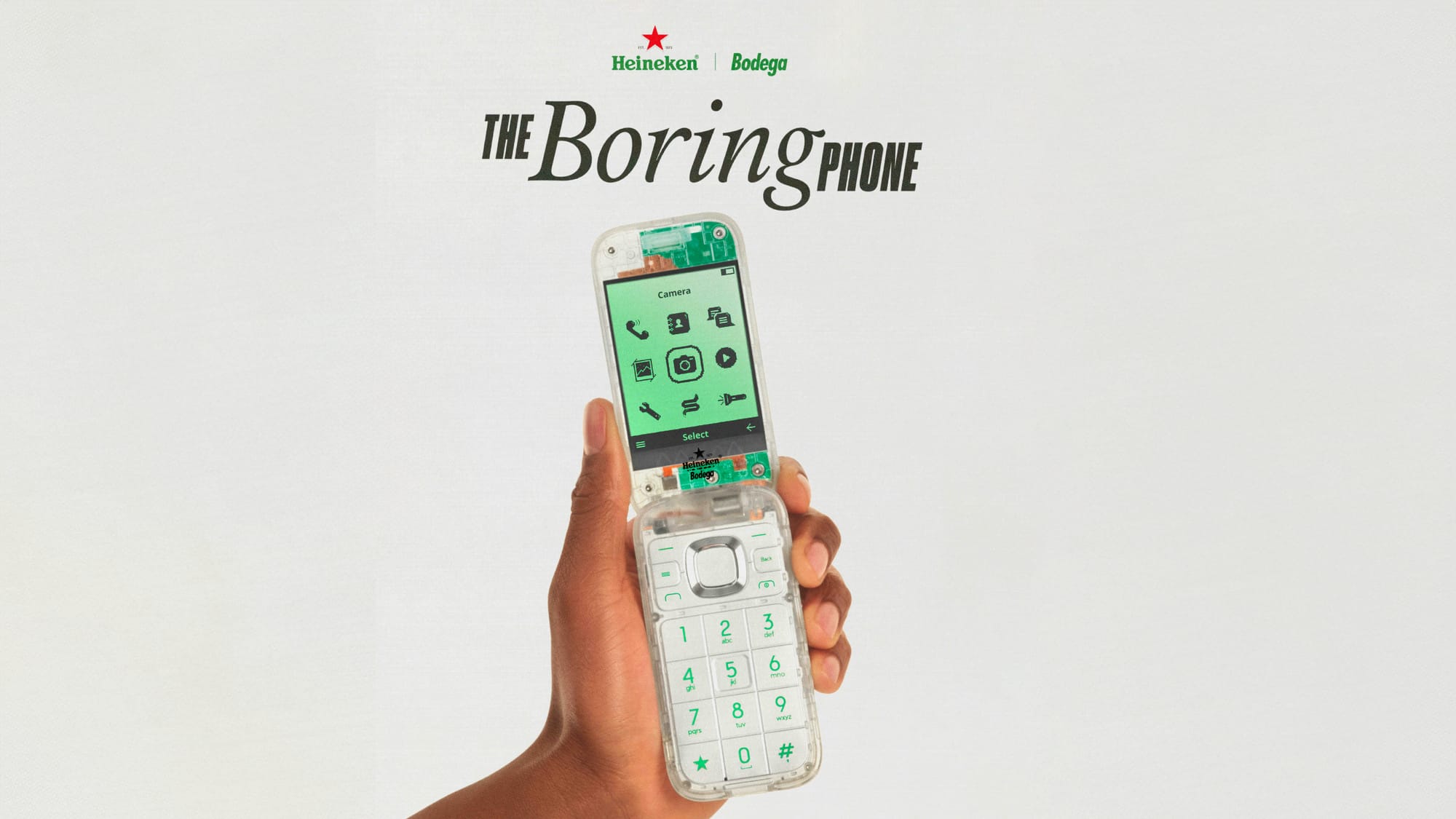
There is, however, a more hopeful side to the analogue shift. Its emphasis on sensory experience has led to the development of more inclusive products – some designed for people with disabilities – reintroducing buttons, knobs, printed materials, textures and tactile feedback in place of endless touchscreens.
But if this movement is to escape its privilege bubble, we must look to the past for answers. Since much of the world moved online, the physical world has changed beyond belief, leaving many people indoors not by choice, but by necessity.
Governments have systematically gotten rid of third spaces. In São Paulo, where I live, parks are increasingly saturated with out-of-home advertising, turning public space into a physical extension of our already chaotic digital lives. History tells us that the Global South often becomes the testing ground for these experiments, so it’s only a matter of time before the consequences spread further.
At the same time, the cost of living has risen so sharply that something as simple as meeting friends on a weekend has become a financial calculation for a large portion of the population.
So how do we reset to real – without turning disconnection into another gated luxury?
The Three Pillars of Real
Any meaningful shift must rest on three pillars: infrastructure, values and laws. Failing to do this will probably result in the same cycle of propaganda we’re experiencing today, where we actively vilify our addiction to phones while sustaining the trillion-dollar industry that profits from it:
- Infrastructure comes first. Governments everywhere must pave the way by creating more parks, green spaces and other communal spaces that don't require QR codes or the internet to exist, while ensuring a minimum level of comfort to people who are trying to disconnect and live a more grounded life.
- The second is values. We need to move from a capitalist-centric worldview to a species-centred one – human and more-than-human. If unplugging makes life more livable for some, it should be possible for all. That starts by putting a stop to treating others as competitors and cultivating a reality that embraces cultures and different behaviours as opportunities to learn and grow, not as differences that must be colonised or taken advantage of for personal profit.
- Finally, laws and incentives matter – but only if they address root causes. Legislation without systemic change becomes performative, a branding exercise disguised as progress.
For brands, the return of tactile media is an early signal of a deeper revaluation: away from speed and scale, toward care, depth and intention. This isn’t an aesthetic trend to package and sell. It’s an invitation to redesign systems that respect human limits, sensory needs and the desire to be present in an increasingly automated world.
| SEED | #8381 |
|---|---|
| DATE | 29.01.26 |
| PLANTED BY | VICTÓRIA OLIVEIRA |
