Why brands need to stop chasing clicks and start bending time.
"Watch Me", a clock designed by Gaetano Pesce in 1995
Virality is becoming a liability. In an always-on culture, when everything is optimised for smoothness, meaning stops sticking. Ana Andjelic makes a similar point: if brands want staying power beyond the length of a feed refresh, they need to move away from culture attached purely to attention.
Content can now be produced quickly and inexpensively. Generative AI is only accelerating what Matt Klein calls “dashboard culture” and Ruby Justice Thelot calls “looksmaxxing” – creative optimisation based on performance metrics. That leads to a feedback loop of sameness, rewarding what already performs. By playing the optimisation game, brands compress the window for creative decisions that look wrong before they look right.
What’s more, with AI agents on the rise – software assistants that manage and filter content, recommendations and purchases for individual users – virality culture becomes increasingly obsolete. As NEMESIS recently pointed out, agents can instantly scan markets to surface the cheapest, fastest-delivered or best-rated option. The result is to strip away hard-won brand loyalty. Any advantage gained from consumer habit is lost if products can be reduced to white-label commodities. So what’s left?
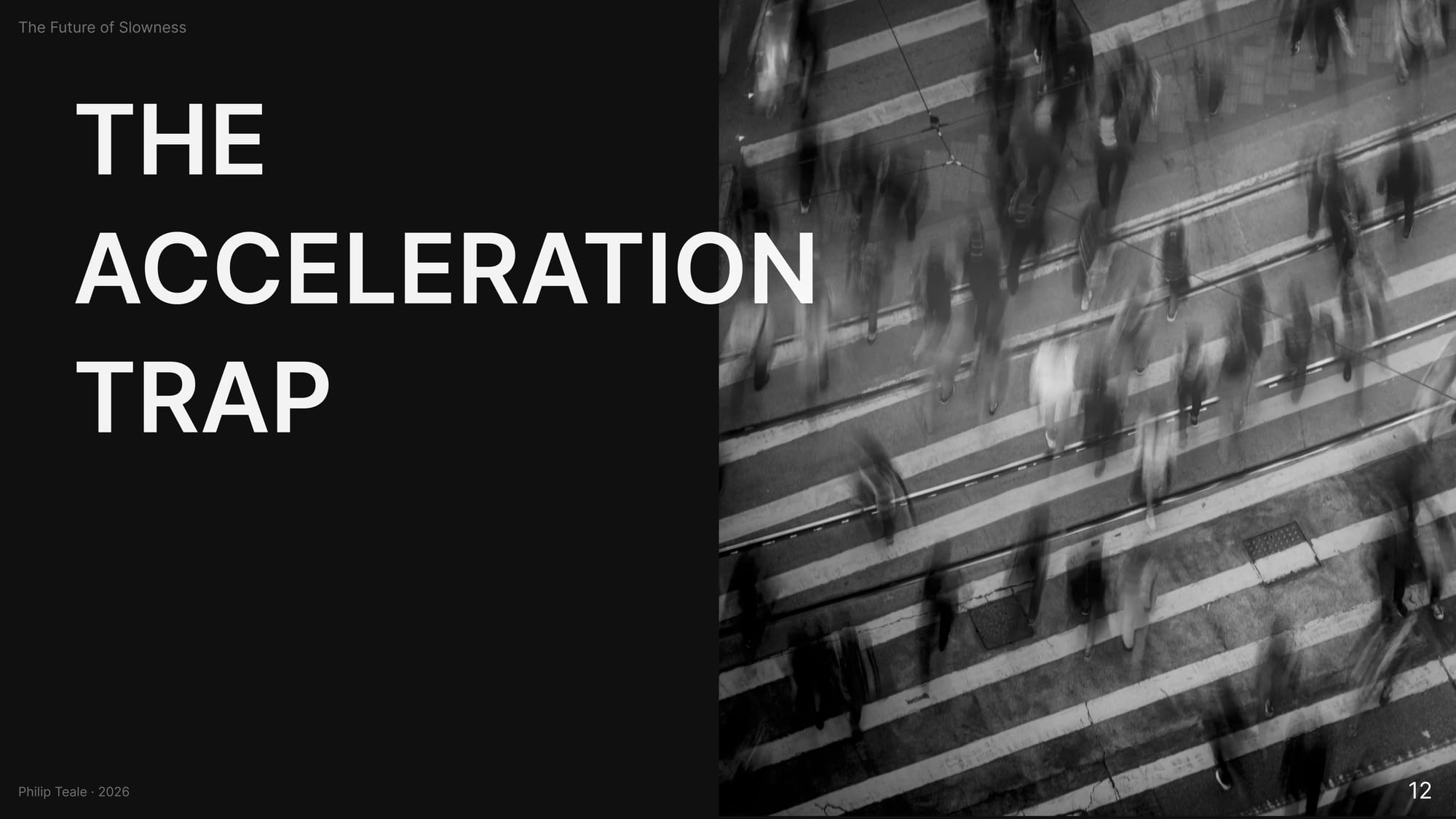
Platforms and agents can’t displace how an experience unfolds over time. At least not at the human layer. Having researched how societal acceleration encourages reactivity for individuals and organisations alike, my findings point to a vicious cycle with diminishing returns. The ability to opt out of this cycle is more aspirational than ever. Brands need to shift their focus away from reactivity and start treating time-perception itself as a creative strategy.
Protein AGENCY provides insight, foresight and strategy for global brands that's rooted in culture and the collective knowledge of SEED CLUB - our decentralised research community of 450+ global experts.