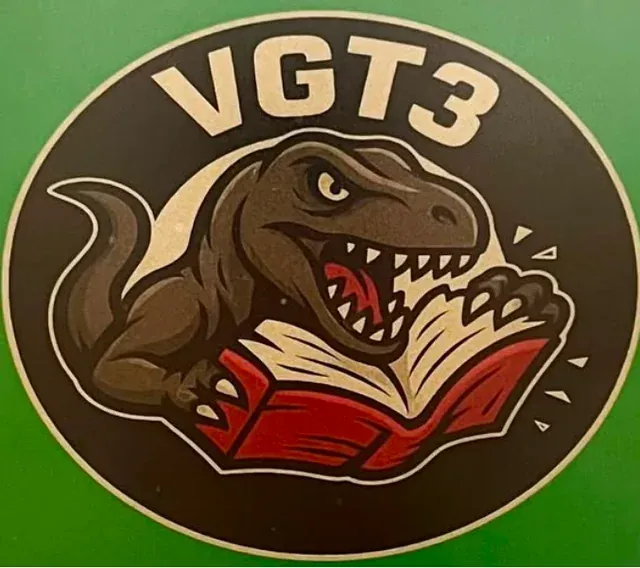
What began as rumours in 2024 came to light this summer: AI companies are buying up rare books, scanning and then destroying them; it being cheaper and quicker to slice the spines off books than preserve them. A recent investigation by 404 Media, in which they attached an AirTag to an order from a rare book seller, revealed the package ended up at an Amazon AI training facility, which houses VGT3, an operation which represents itself with an image of a dinosaur reading, or ripping apart, a book. Anonymous booksellers told 404 Media these bulk orders of rare texts had been accumulating in a very orderly fashion: it seemed buyers were methodically working through the serial numbers uniquely assigned to published texts.
Amazon has been digitising books for decades, but this practice points to something new, something more insidious. Already, AI limits the information it provides us with, which is highly susceptible to reinforcing the biases entrenched in culture and society. Slowly, and then seemingly all at once, these systems are dictating what knowledge is available to people; something which these recent revelations only further support.
The symbol for Amazon's VGT3 scheme
The acquisition and destruction of books picked up pace after AI companies came under fire for copyright infringement. Anthropic’s Project Panama, a previously secret mission, was exposed in Bartz v. Anthropic: a $1.5 billion class action lawsuit on Anthropic’s unauthorised use of copyrighted books to train its AI models. As court exhibit 21, an internal memo by Anthropic, reveals: ‘Project Panama is our effort to destructively scan all the books in the world’. Encouraging total discretion, the memo continues, ‘Why use a codename? … [B]ecause we don’t want it to be known that we are working on this.’ The question is why exactly.
One potential answer comes from SEED CLUBBER Julián Medrano Hoyos: ‘Books are one of the most powerful objects humans have ever invented and this to me is a clear example of how these big tech firms are trying to monopolise human knowledge.’ In response, Amir Gamble suggests combatting this has to come from collective resistance: ‘I think it's a public duty to push back on stuff like this. Not just with activism, but learning to be archivists collectively.’ Physical (or server-based) media as both rebellion and archivism is precisely what Willem Deisinger examines in the SEED Piracy’s Back. Pirated material was almost entirely streamed in 2023, but by 2024, 50 per cent was downloaded, demonstrating a desire for media ownership, even if acquired illegally.
Protein AGENCY provides insight, foresight and strategy for global brands that's rooted in culture and the collective knowledge of SEED CLUB - our decentralised research community of 450+ global experts.