



A recent post on X sparked discussion about Gen Z’s growing habit of “being a regular” at neighbourhood cafés, restaurants and shops – maxxing out the depth of a few place-based relationships and the benefits that come with them:
regularmaxxing changed my life.
i go to the same café every day to work. and tip between 30-50%.
now i walk in like i own the place:
- they gave me a paid-for parking spot
- when i bring friends, they get orders for free
- can make myself off menu drinks
- can send my parcels there
- they are community, introduce me to other regulars
- got employee wifi, kept my mac charger there
i did that in nyc, cpt, bcn. it works everywhere if you stop chasing the dopamine of “new”
Business Insider then framed it as Gen Z’s response to the fatigue of chasing what’s new in town, often at the expense of more durable social connections:
Exhausted from years of chasing exclusive reservations and trendy foods from viral videos and ordering app deliveries from ghost kitchens, young adults in America are now looking closer to home for something you can’t promote on Instagram and TikTok: their own version of Central Perk [in Friends] or Cheers. These local bars, restaurants and coffee shops where everybody knows your name are most notable for what they mean to their regulars more than what they’re selling to anyone outside of the neighbourhood.
On X, reactions ranged from calling it the greatest life hack of all time to seeing it as a telling signal of how many aspects of social life were eroded – and replaced – by immaterial substitutes for real relationships. Hidden among hundreds of comments were more reflective takes on what regular-maxxing actually is, and how it works:
“I do this too but with 3 places in rotation. One café = one community. Three cafés = three networks that cross-pollinate. Single café you max out the network quickly. You know everyone. You’ve met everyone. The serendipity flattens.”
“What you unlocked isn’t about money or tips, it’s about: showing up predictably, treating people generously and with respect, and becoming part of a micro-community”.
“No, I’m saying that an incremental tip of $1-3 has 10000x the ROI of spending that on virtually anything else”
So what is this, really? An attempt to carve out pockets of predictability in an increasingly uncertain reality? Extractive behaviour disguised as care? Or a universal desire to feel like we really count in an era of social atomisation? A friend once defined luxury as “getting everything good in life without asking, absolutely for free.” The most revealing part of the discourse is how often people emphasise the non-monetary perks – adding texture to the original claim: “I walk in like I own the place.” For some, regular-maxxing equals the good feeling of getting:
- menu items named after you
- handwritten cards when staff hear you’re moving
- invitations to employees’ birthday parties
- appointments reshuffled to make room for yours
- mushroom-foraging tips
- access to staff-only backyards where you can smoke weed
- shopping before opening hours
- staying after close, just to hang out
Regularmaxxing, in this sense, is less about optimisation than about relational surplus – the moments where commercial logic quietly dissolves. I recently had a regular-maxxing experience in a family-owned hardware store, where they repeatedly recommended the cheapest or second cheapest option available, clearly “protecting” me from falling into commercial traps placed there for all the folks with little experience and an even smaller desire to get to know them.
At the same time, the “maxxing” suffix itself has spread everywhere: ambiguity-maxxing, protein-maxxing, knowledge-maxxing, friction-maxxing, nervous-system-maxxing. Why the urge to reframe ordinary habits as performance metrics? What feels so transgressive about liking regular things?
“I’m not enjoying average coffee – I’m regular-maxxing.” “I’m not going down rabbit holes alone – I’m knowledge-maxxing.” Narrative Botox for the mundane, somehow making it feel more legitimate.
Philip Teale, a SEED CLUB member, draws a connection between regularmaxxing and the original logic of normcore, as defined by K-Hole in their 2013 Youth Mode report:
“Once upon a time people were born into communities and had to find their individuality. Today people are born individuals and have to find their communities. Normcore doesn’t want the freedom to become someone. Normcore wants the freedom to be with anyone. In Normcore, one does not pretend to be above the indignity of belonging.”]
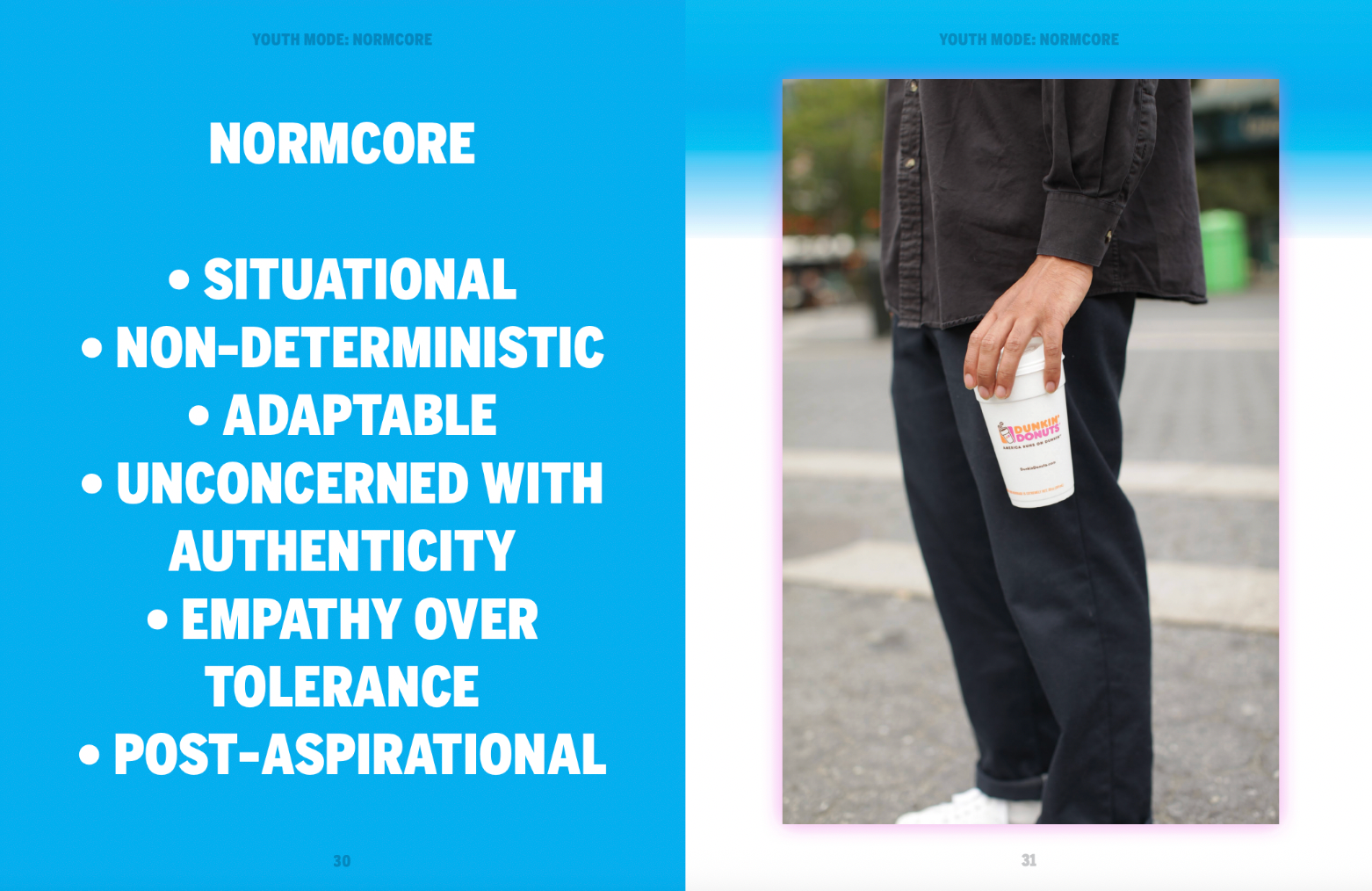
And yet, there’s a linguistic paradox at the centre of it all: a desire to escape a metrics-obsessed world, expressed through a word that contains measurement itself – maxx.
Some of the my favourite regular roasts capture this tension perfectly:
- “Routine is called regular maxing now”
- “This feels like a completely American approach to try to make friends and create community by throwing money at people”
- “This only happens in white cities”
As an immigrant in the US who intentionally spends part of the year on a small fishing island, regularmaxxing feels less like a hack and more like a refusal to be treated as a tourist forever. In many smaller towns and marginalised communities, interdependence isn’t aspirational – it’s reality. Bar owners stagger their days off so they can drink at each other’s places. Disagreements don’t escalate because everyone relies on everyone else – emotionally, physically, financially.
Is that resilience-maxxing? Or simply what happens when life hasn’t been fully flattened into transactions and rewards?
This distinction becomes sharper when contrasted with platform-mediated loyalty. Business Insider notes that:
Money spent via Blackbird app increased by 1,000% in 2025, allowing patrons to reserve a table, pay the bill and earn perks at local stores.
Bilt, the rent rewards platform that aims to make every aspect of where you live more rewarding, got valued last summer for over $10 billion.
Techno-centric solutions promoting fabricated loyalty clearly work. But it will never feel the same as receiving something from another human being who had no obligation to give it. That unpredictability – the serendipity – is precisely what makes it meaningful. It’s an invisible bond with a very visible outcome: proof that your presence matters.
Maybe regular-maxxing is simply Gen Z recognising the difference between reward-maxxing and relationship-maxxing, via a detour into informal economies. Thankfully, there are still places that make this distinction tangible. Places where the wifi is spotty, but your face still has face value – determining the discount you get, or the extra thrown into your bag. Not because of an app, but because people remember your presence, your contributions, your existence.
| SEED | #8382 |
|---|---|
| DATE | 03.02.26 |
| PLANTED BY | ALICE JASMINE CRIPPA |
