With no fixed point of reference, meaning spreads fast and splinters even faster, creating a network of micro-scenes.
Culture is the set of shared assumptions that organise collective life for a group of people. It’s the background upon which meaning, value and behaviour become coherent.
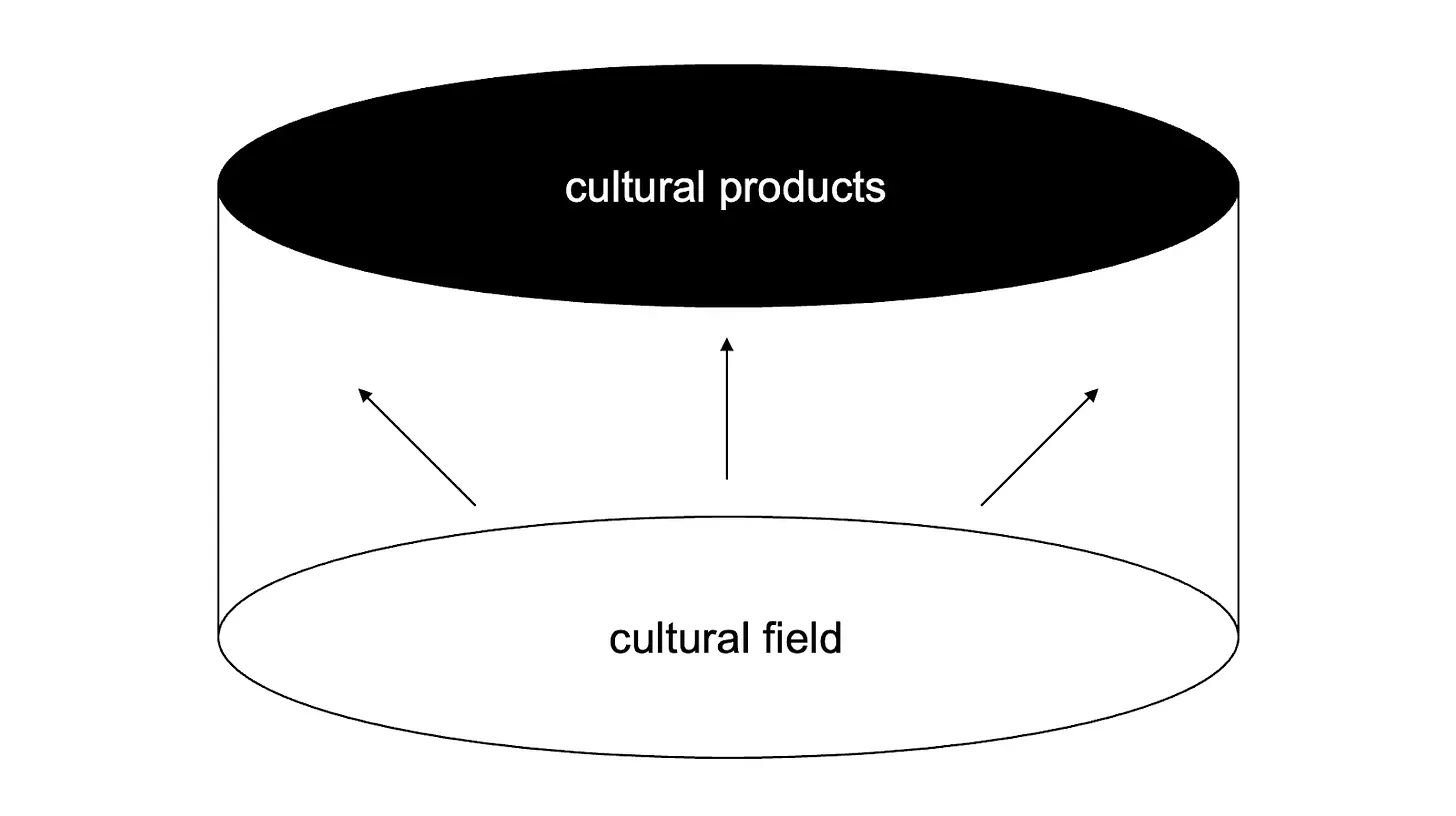
Culture is also movies, memes, fashion trends, ways of speaking, books, operas, plays and paintings. Cultural products are material expressions of this deeper field that coordinates what’s valued and what’s allowed. Culture is both at once.
Culture is both at once
It’s like an organism. The field is its DNA, and cultural products are its outward expression. Like an organism, culture also has certain behavioural patterns:
It always moves from areas of high constraint to areas of low constraint. Over time, culture gets crowded with too many people doing the same thing and it becomes harder to express something new or to gain attention (to get status). People start moving into different ways of expression where norms feel looser and novelty is easier. These new spaces inevitably attract attention and eventually stabilise into new constraints (just as, to any scene, first come the nerds, then come the psychopaths to mine it for profit). This is what drives culture’s eternal cycle.
Because culture feeds off human attention, what culture is made of will be what captures a lot of it. Because it takes more time and energy to transmit complex ideas, simple ideas spread more easily. So do those that are emotionally resonant or already recognisable (archetypes, for instance, are already path-dependent).
Certain narratives, visual styles and behaviours recur because they successfully encapsulate a shared feeling or identity that they can also successfully transmit across time. There were goths in the 80s and there are goths today, because the aesthetic still remains a clear way to signal a specific mood and worldview. On a larger timescale, these stable patterns are known as archetypes, with the goth being just one manifestation of the eternal “rebel”.
Culture is always reconstituting its own boundaries. It redraws distinctions between the sacred and the profane, insider and outsider, elite and common, authentic and inauthentic. Culture mutates as conditions change. It’s a living system constantly reorganising itself.
An organism’s environment influences how its natural tendencies are expressed. Culture’s environment is information. This means that whenever the dominant medium of communication changes, so does the way culture manifests.
There have only been a few distinct media regimes over the course of human history: oral speech, handwritten script, print, broadcast media and digital networks. Each medium has different characteristics that determine how fast information can travel, how reliably it can be transmitted, how it’s stored, who gets to distribute it, etc.
Protein AGENCY provides insight, foresight and strategy for global brands that's rooted in culture and the collective knowledge of SEED CLUB - our decentralised research community of 500+ global experts.