Linguistic Homogenisation ≠ Kinda Chic
Why vocabulary is becoming dominated by labels rather than descriptors.
“I really prefer the word elegance. “Chic” has lost value in its native country — “Chic alors!” cries the street urchin on finding 10 francs in the gutter — and it never had much prestige in England,” Nancy Mitford writes in her 1951 essay for The Atlantic. Ever since chic first crept into the common vernacular – sometime in the mid-1800s – its definition has been slippery and contested.
While Marie Solis in The New York Times states, “it has become “kinda chic” to declare the death of the word chic”, the implications of limiting our language to that sourced from our feeds are worth examining.
The word chic suffers from the same affliction as the word culture, as Clive Martin laments in the SEED Vulture Culture: there’s no synonym that even gets close to its enigmatic mix of nonchalance and glamour. Chic has experienced many iterations in its time: boho-chic, geek-chic, and lest we forget, heroin-chic. The latest update? Kinda chic.
While the "kinda chic" trend began ironically – ascribing the essence of chic to something random, nonchalant, unassuming – it’s spun out into the ridiculous and now applied to literally anything, be that having a low like count or eating toast. Other assertions of "kinda chicness" are too obvious: reading, going to galleries, playing an instrument. Generic cultural activities that haven’t earned a position in chic’s evasive echelons.
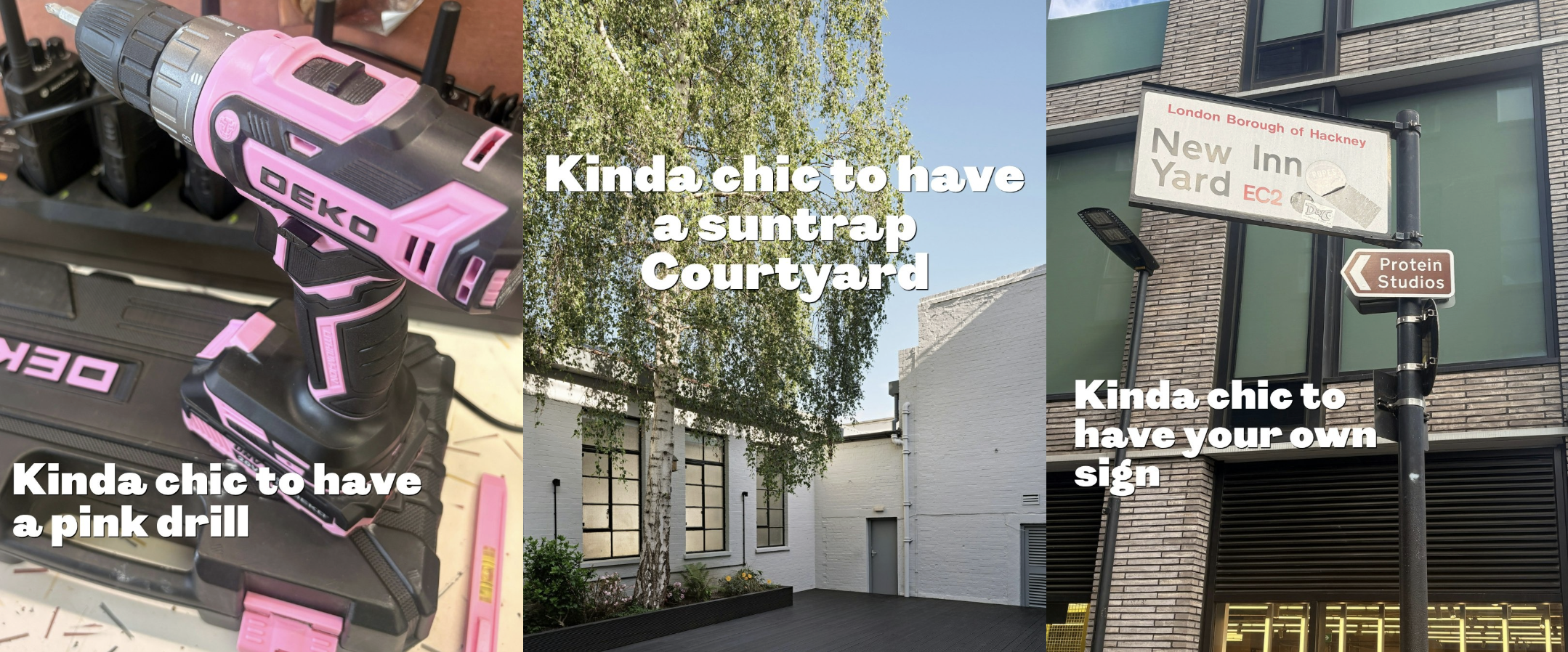
It seems anything could be bolted onto the "kinda chic" prefix and it would stand. Kinda chic to trim your toenails. Kinda chic to take the bins out. Kinda chic to eat leftovers for breakfast. The trend’s gone so far that our very own Protein STUDIOS is now talking about their 8.5 metre ceilings and pink drill being kinda chic. No one is immune.

The most interesting analysis of the trend is not around the word chic itself, but the shrinking of our vocabulary that it's a symptom of. Perhaps there’s significant cultural grounding for why people want to be more chic, but we could swap chic out for cool, niche, iconic or demure, and it would point us in the same direction: a reduced lexicon reduces expression, which reduces understanding and human connection.
This is reinforced by falling reading rates and rising AI influence. Earlier this week, a study published in Nature –"AI writing assistants shrink linguistic diversity and blur personal identity" – confirmed what we’ve been observing: LLMs “homogenise writing style”, with writing becoming less and less varied as AI use spreads. "Kinda chic" precisely illustrates this.

In a recent video, Rachel Lowenstein argues that when everything is kinda chic, nothing is kinda chic. She goes on to explain how it’s easy to jump on a trend because it “makes it easier for the algorithm to categorise you when you’re using a format that it already recognises.” For brands, this of course holds great appeal – a tactic to get your content in front of as many people as possible – but as Brenda Weischer (a.k.a @brendahashtag) writes in her Substack on template slop, “while I am sure there are actually paid activations currently happening with that trend, it doesn’t really benefit anyone. Not the creator for an unoriginal idea (unless there is very original execution or storytelling) and definitely won’t get the brand that’s paying any cultural currency.”

This connects to another recent trend: repeating the same phrase with different emotional tones, which Clara Fulks theorised was in fact started by Big Tech and “going viral because [they] need emotional training data to train their emotion recognition models”. Language shifts from a tool of personal expression to a tool of algorithmic optimisation.
Assessing the "kinda chic" trend through the lens of cultural austerity, Lowenstein outlines how “we have more labels and fewer descriptors”. Rather than personal, considered word choices, the language we use online becomes limited to what will be picked up and spread most efficiently, which then bleeds into our everyday vernacular. Increasingly, this sees sincerity stripped away from our communication, which Ethel Cain described as an “irony epidemic” back in 2024. You don’t need to be vulnerable when you can be a meme.
As language collapses into something constrained, so does the structure of content. As previously mentioned, this is something people are calling template slop. The message itself doesn’t really matter if it follows a certain aesthetic style and format, such as colourful text over image, subtitled stills, or videos starting with a bold statement before the creator interrupts themselves with something along the lines of “But before we go any further, hey, I’m X, a Y interested in all things X.” Once again, the medium proves to be the message.
One SEED from July last year explained why typos are chic: the slip-ups that demonstrate writing was human-written are charming rather than embarrassing in the context of instantly generated AI text. Now we can’t help but wonder: did we subconsciously play a part in creating this kinda chic monster?
If we were to assess the cultural conditions which make chic so desirable right now, it appears to be a mutation of people’s fixation with taste. An essay in our Stupid REPORT, "Vulgar Taste Is Vital", pays homage to Diana Vreeland’s philosophy: “We all need a splash of bad taste. No taste is what I’m against.” Indeed, “Never fear being vulgar, just boring,” was one of Vreeland's favourite quips.
When we try to be tasteful, chic, niche, whatever it may be, we forget something integral to any one of these things: personal idiosyncrasy. Speaking to The New York Times, Emily Segal explains that “Cookie-cutter taste is by definition bad taste because taste is by definition relational and relative. You can’t just clone some situational idea of good taste and hold it up as good taste”. Trade taste for chic and her argument still stands.

One column in the 7th October 1877 issue of The New York Times, entitled “What Is Chic?", attempted a definition. The author asserts, “Chic is to fashion what poetry is to prose, cold veal to roast partridge”. They continue, “You cannot copy it. You never know where to look for it. It has the quickness of a humming-bird and the vitality of an eel.”
The solution to linguistic homogenisation is diversity – of literature, of authors, of mediums. When these trends crop up, it can be tempting for brands to ride the wave. But as Weischer says, jumping on an unoriginal idea won't win you any cultural currency. That can only be sourced through effort, exploration and independent thought.
| SEED | #8440 |
|---|---|
| DATE | 27.08.26 |
| PLANTED BY | PROTEIN |