

Let Me Explain

A short theory of why everyone’s explaining everything online now.

The internet keeps insisting it can’t concentrate. And yet, it has endless patience for six-part theories, hour-long video essays, multi-slide Canva explainers, and floating heads talking at length in front of green-screened receipts. Whether it’s a relationship pattern or news still unfolding, before the dust settles, a theory is already circulating.
This is often framed as a speed problem. Takes surface quickly, frameworks assemble, verification lags. With this logic, interpretation starts to look like a byproduct of velocity itself – confidence rushing in to fill the gap left by missing context.
It’s a tidy diagnosis. And like most tidy diagnoses, it avoids the question it quietly raises. If our ability to process information is really shrinking, why does the urge to decode everything feel so persistent? Why does commentary keep proliferating even as comprehension is supposedly in retreat?
Thinking Out Loud
There’s a recognisable rhythm to contemporary posting: the preface, the orientation, the ritual clearing of the throat. Here’s what you missed. Nobody’s talking about… Quick explainer. The pattern repeats across platforms and topics, offering a low-friction way to enter the conversation before the moment passes.
What seems to be shifting isn’t just attention, but where thinking happens. What once unfolded privately now increasingly plays out in public, in fragments, often mid-thought, often in front of an audience. Posting is no longer the final step after an idea has settled; it’s an intermediate action, a way ideas are stress-tested in real time. When your first contact with culture is already mediated by interpretation, commentary becomes the starting point rather than the afterthought – like sketching a map while still walking through the terrain.
The Explanation Reflex
This reflex is also structural. Culture now arrives pre-shattered: headlines severed from articles, screenshots lifted from threads, discourse floating loose from whatever sparked it in the first place. You might still encounter the original “event,” but more often you meet its afterimage, filtered through someone else’s frame. The baseline experience of culture becomes less about seeing something and more about being told what it means as you’re seeing it.
This helps explain why familiar formats – stitches, duets, reaction videos, video essays, memes – feel less like responses and more like processing tools. Meaning is produced through circulation because it’s already been partially digested, compressed into something the algorithm knows how to carry.
For brands the implication is subtle but important: audiences aren’t waiting for conclusions so much as orientation. It’s not that everyone suddenly developed the patience or parlance for theory. It’s that explanation is one of the few ways to make something hold still in a medium designed to keep moving. When the world feels incoherent, the explainer offers a temporary handrail. Not always correct. Not always rigorous. But something to grip. Audiences are entering moments unfinished, looking less for authority than for something that helps them locate themselves.
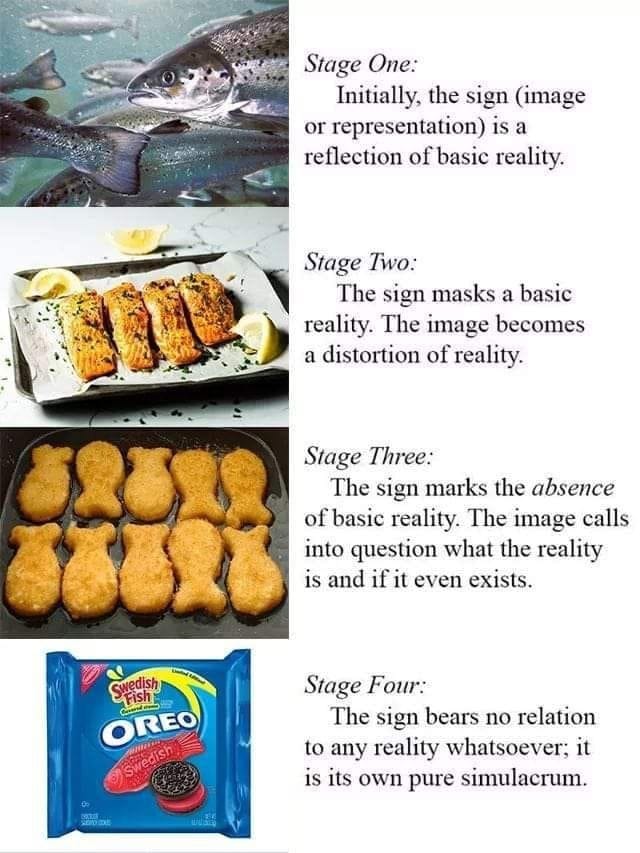
Jean Baudrillard's concept of simulacra
The Commentary Loop
Instead of encountering an event, forming a private interpretation, and then sharing a considered response, sense-making now moves through a tighter circuit, where commentary arrives before thought has fully settled. Each pass compresses and reframes the signal – not necessarily out of bad faith, but because circulation itself performs a kind of editorial work, privileging what’s repeatable, emotionally sticky, and easily paraphrased over what’s precise.
Even flawed explanation carries comfort: someone, somewhere, tried to connect the dots. You can stand on that scaffolding long enough to build your own view. This is why attempts to “cut through the noise” so often misfire. In a culture shaped by loops, clarity doesn’t come from being louder or simpler, but from understanding where – and how – people are already mid-interpretation.
Orientation Mode
Not all explainers behave the same way. Some offer genuine orientation – slowing a moment just enough to make it legible, offering a frame rather than a verdict. You know it when you see it: the writer who admits confusion, the creator thinking through something on camera, the newsletter that investigates instead of declares.
Elsewhere, explanation hardens into performance. MasterClasses promising to decode genius in 12 videos. Business Insider breakdowns that manufacture certainty from correlation. Every TikTok declaring here’s why everyone’s obsessed with X when nobody was until the video said so. In these cases, explanation becomes less about sense-making and more about position. As brand strategist Nikita Walia puts it, ideas become “aesthetic objects meant to be consumed, rather than wrestled with.” What once invited dialogue now functions as display.
This is the fault line for brands: between helping audiences think and perform certainty on their behalf. The former builds trust slowly. The latter travels faster – until it doesn’t.
Are We Post-Primary Source?
Most encounters with culture now begin one step removed. The primary source matters less than the explanation that reaches you first – whatever framing surfaces in the feed, already shaped by tone, timing and repetition.
When direct contact thins out, interpretation multiplies. Culture moves through increasingly derivative loops, where explanations accumulate faster than events themselves. Everyone’s a critic because everyone has to be. When commentary becomes the primary interface for culture, explanation is the price of admission.
| SEED | #8376 |
|---|---|
| DATE | 12.01.26 |
| PLANTED BY | NATALIE PODAIMA |
