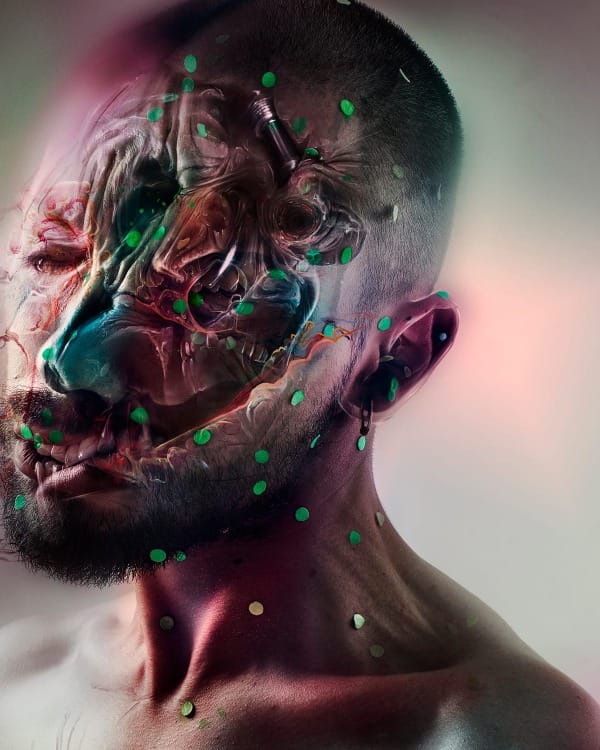
Ugly used to be what we turned away from – now it’s increasingly what we seek for comfort.
My coffee brews with a hollow hiss. Steam curls upward like it’s trying to escape. I scroll while I wait – art, memes, otters, then war, sex, therapy, deepfakes, burning cities, dancers under purple lights.
Memes blur by, DMs pile up. The coffee’s still not done. My phone pulses with life, unlike the tax reports on my table. I don’t want to be an adult today. I’m numb, restless. Something cuts through: a FaceTime call. A woman making breakfast looks straight at me. For a second, I feel seen. Less alone. Then her head twists. She wheezes like a kettle. It’s AI.
Just another Tuesday. But I feel dislocated. I sip my coffee. It’s bitter. Is this what ugly feels like now?
The Gout by James Gillray (1756-1815)
An Ugly Conception
Historically, ugly has always been a warning. The word itself comes from uggligr, Old Norse for “to be feared”. It signals threat – like rotten fruit, a sign of disease or disorder. Ugliness evolved with us as a protective mechanism: don’t touch, don’t eat, don’t trust.
Today, however, our environments are climate-controlled, and most threats are invisible. Data leaks, burnout and misinformation have replaced tigers and toxins. Ugly no longer breathes in the skin but in the feed. In curated stories revealing realities we most likely won’t experience, yet our brain does not discern.
We scroll past genocide, brunch, trauma-core memes – and rarely flinch. Ugly is no longer in the flesh but in the blur. In the eeriness of not knowing what’s real – or worse, no longer caring about it. The new ugly focus less on the form of things but on depraving our suspicions.
Flinch by Jon Jacobsen (2017)
The Desensitised Self
There’s no time to metabolise anymore. In a few minutes, we’ve seen more than what a Victorian experienced in a lifetime. Culture offers everything, everywhere, all at once. Our bodies, untrained for this volume, quietly collapse.
Protein AGENCY provides insight, foresight and strategy for global brands that's rooted in culture and the collective knowledge of SEED CLUB - our decentralised research community of 500+ global experts.