

Vintage As The New Luxury

Why history – and importantly friction – are making fashion personal again.

The boom in vintage has been around for a while – the idea that it’s the “hottest thing in fashion” – and I think that a big part of this can be attributed to the idea of friction: the thrill of the search, unearthing treasure rather than the anonymity of click and buy.
Beyond the anonymity of online shopping, vintage responds to an even deeper layer of anonymity in fashion. Over the past decade, streetwear has dominated the luxury industry, prompting luxury labels to abandon the qualities that once defined them – craftsmanship, attention to detail – replacing them with oversized logos on bags, hoodies and T-shirts. These logos became the driving force of the entire industry. The rise of vintage – and its position as the new luxury – is a reaction against this shift. As luxury grew more anonymous and detached from its roots, vintage emerged as its opposite.
Part of vintage’s appeal lies in its history. Every piece – whether an old band T-shirt or an archive Margiela – is rooted in a specific time and place, carrying a journey that brings it to the present. Things brings to mind the anthropologist Igor Kopytoff’s idea of an object biography, one that shows an object as “endowed with culturally specific meanings, and classified and reclassified into culturally constituted categories.” All objects have biographies, but vintage boasts of its biography. Luxury clothing used to emphasise craft, high quality fabrics and painstaking details, which all formed part of its biography. As it was replaced by streetwear, however, the industry deliberately flattened these histories in favour of a logo. The embrace of luxury shows how these biographies still matter.
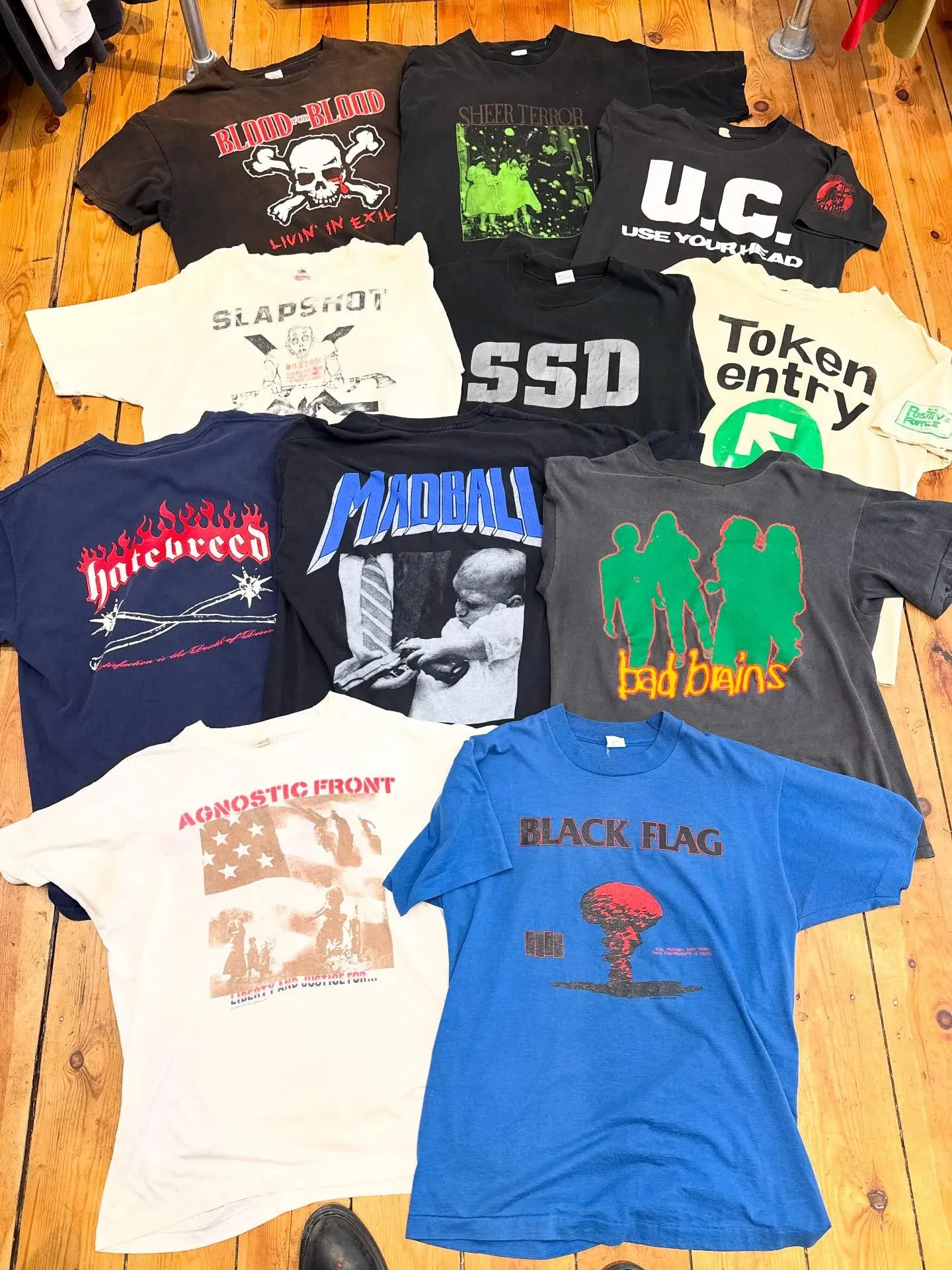
“Biography is one of many factors that go into value,” says Bijan Shahvali, the brains behind Intramural, a New York-based vintage store with its own accompanying newsletter. “Rarity, novelty and condition also factor into the value. What is also interesting to me is when someone has a personal connection or story to a vintage object.” If you take Kopytoff’s definition of biography, each of these elements will contribute to each item. Every single T-shirt has a biography – one that might encompass bigger themes like a band’s career or a certain tour, as well as more everyday concerns such as its condition and fade. “You could wear a thrashed, faded shirt and it’s one of one because the specific wear is unique to the garment,” says Shahvali.
Such uniqueness drives the appeal of vintage clothing. “In an age of algorithms and homogenous style, vintage has become the only way to have any personal style or separate yourself from the herd,” he says. “You could wear archival designer pieces or a rare T-shirt from your favourite band and make it feel personal. Vintage is not going anywhere and I think it’s a really great time for it – people are mixing new and old in an interesting way and having fun with it.”
To tie that back to the idea of friction, I think you can see that “homogenous style” as something that comes from seamlessness, served to us all and easy to consume. Vintage, on the other side, comes from friction. It’s worn, beaten, faded, thrown away, rediscovered, cleaned and photographed – all before it makes it to you.
There’s also an element of cultural capital that feeds into vintage’s current popularity. At Intramural, Shahvali focuses on “cultural relics,” which he describes as “items that have maintained art and cultural relevance over many decades.” Such T-shirts communicate and reaffirm cultural capital in two ways, firstly through the references displayed on them, and the assumed knowledge to understand them, and secondly through the implication of a search for each item.
“I use the term relic because the items are originals from the actual time period or place this culturally relevant event took place,” Shahvali continues. “For example, a bootleg T-shirt for Jeanne-Claude and Christo’s The Umbrellas that was sold in central California. I want people to sound like Adam Sandler in Uncut Gems saying 'that’s history right there, you understand?’ when they are referring to the hat they’re wearing or the object on their shelf.”

In Shahvali’s description, these relics make up our cultural and communal history, rather than just T-shirts or knick knacks. In doing so, he brings to mind another piece of Kopytoff’s writing. For Kopytoff, items may be seen as commodities only by certain people, or become commodities at certain times before fading away again. In other words, merchandise produced for an exhibition 30 years ago or a T-shirt from the US Open 1995 are worthless, outdated or throwaway. For others, they are elevated to something else, becoming commodities (to use his phrase) or cultural relics (to use Shahvali’s). “The cultural responses to such biographical details reveal a tangled mass of aesthetic, historical and even political judgements, and of convictions and values that shape our attitudes to objects labeled ‘art’,” writes Kopytoff.
The importance of vintage is obvious, then. It’s also an interesting example of different commodity classes. On the one hand, it’s the point where cultural capital and object biography converge, a combination of age, condition and references, from Levi’s BigE logo or a certain band graphic that feeds into lore and legend. On the other hand, it shows the ways that friction is influencing particular industries, pushing out the anonymity of seamlessness, at least partially.
“I don’t think vintage is replacing luxury, but I do think we are appreciating and viewing vintage from a similar lens as the view of luxury is shifted,” says Shahvali. “Luxury is less about signalling wealth and perhaps more about signalling taste. Luxury is about things that stand the test of time, both in terms of quality and cultural relevance. With this shift, vintage definitely offers a different approach to luxury. I really like this quote from Thomai Serdari I heard the other day that I am going to paraphrase and hopefully not butcher too badly: ‘If you want to know your product is a true luxury product, you should ask yourself if you can envision being in The Met one day.’”
Jack Stanley is a writer, strategist and anthropologist based in London. This essay was initially published on his Substack, Heavy Weather.
| SEED | #8358 |
|---|---|
| DATE | 21.10.25 |
| PLANTED BY | JACK STANLEY |
